Food trends come and go, shaping what we eat and how we think about health. From plant-based to low-carb, with each new wave comes a surge of products designed to cash in. But behind the marketing, what does the evidence on health really say? And how do these trends relate to the realities of farming and food production? Joanna Blythman takes a closer look, through the lens of protein.
Suggest to the beefy blokes lifting weights in the gym that ‘high protein’ is merely the latest food-fad, and they’ll put you right. They have long seen a high protein diet as the only way to build muscle and need no persuading that a daily plate of steak and eggs could only be a good thing. But in recent years, high protein diets have crossed over from the sports nutrition domain to capture a much wider market, one with a more feminine demographic.
We were probably ready for that change of message. The ubiquitous ‘plant-based’ trend peaked in 2021 and has been losing ground ever since; UK plant-based food sales fell 4.5% in the year to January 2025.
Veganism, its most extreme incarnation, is right off the boil. An eating pattern that always appealed more to women than men, its Waterloo moment in the UK, came last year when the former head of communications at Veganuary quit her role to advocate a shift away from veganism to ‘less and better’ meat-eating. The proposition that populations would eventually transition to a diet free of animal-sourced foods proved to be a harder sell than its ardent proponents had hoped.
But another significant factor powering the taste for high protein is the arrival on the market of GLP-1 weight loss drugs, such as Ozempic, Wegovy and Mounjaro. Available from GPs, or unsupervised over the internet, these drugs suppress appetite and reduce overall calorie intake, but they also cause loss of lean muscle mass.
Nutrition advisers of a ‘Keto’ inclination have habitually stressed the value of protein-rich foods as a means to feel fuller longer. But now that so many people – once again, a majority of them women – use weight loss drugs, higher protein intake is advanced as the prescription for muscle repair during periods of rapid, drug-induced weight loss. “Muscle mummies”, who are full of the joys of a high protein diet combined with resistance training, attract more social media ‘likes’ than ‘cardio bunnies’ who remain loyal to Zumba and low-fat as the formula for weight control and health.
Perhaps it’s a reaction to the plant-based craze, but more people now seem to understand the fact that animal-sourced foods – meat, fish, dairy and eggs – are typically nutrient-dense, much higher in protein, weight for weight, than plant-sourced foods. Furthermore, it is gradually becoming more widely appreciated that the protein in meat, dairy, eggs and fish is more ‘complete’ in terms of providing the nine essential amino acids we need, in their most easily absorbable, digestible forms; the Sustainable Food Trust’s Grazing Livestock report has noted that, “…grass-fed meat and dairy tend to have superior nutritional profiles compared to their grain-fed equivalents”.
The Digestible Indispensable Amino Acid Score (DIAAS), endorsed by the FAO as the most accurate method of assessing protein quality, measures amino acid absorption in the small intestine. By this score, animal proteins (meat, egg, dairy, fish) score higher than plant proteins. On the DIAAS scale, beef and eggs, for instance, score 1.22 and 1.12 respectively, while kidney beans and oats score 0.61 and 0.44 respectively.
Soy is one of the highest-quality plant proteins, with a DIAAS score of 0.92, but consumer attitudes towards it are mixed, with taste preferences and perceptions varying widely across populations.
The role protein plays in supporting hormonal health, by regulating our appetite and stress hormones, has now emerged as a talking point. In women’s health circles, where the perimenopause and health in ageing are big issues, protein is commonly discussed as a strategy to combat muscle loss, stabilise metabolism, manage weight and maintain bone health, as oestrogen declines. The logic here is that women need to get less energy from carbohydrates and fats, and more from protein, to compensate for the biological changes that occur at menopause.
Over the years, government ‘healthy eating’ guidance has told us that overconsumption of fat is making us sick and obese. The low-carb lobby has argued back that carbohydrates, so rapidly digested as sugar, are the real culprit – not fat. Enter the ‘Protein Leverage Effect’ theory. It focuses on the satiating effect of protein and postulates the idea that without an adequate proportion of protein, the body’s drive to reach its target protein intake will make us continue to over-eat unnecessary energy from fats and carbs until we get the protein we need.
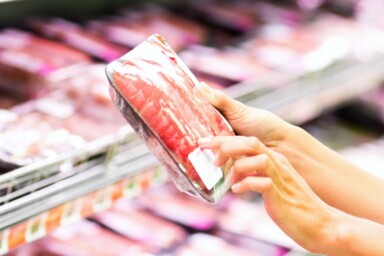
Heightened awareness of protein’s critical role in maintaining good health is, of course, good news for livestock farmers. UK meat sales saw a substantial upswing in 2025. We spent £500 million more on meat products.
Meat is off the naughty step, at last. The ‘yuk’ reaction towards meat has taken another knock from soaring interest in bone broth. Our grandmothers and great-grandmothers always had a stock pot of bones and carcasses bubbling away and saw that precious liquid as a foundation for good health. Bone broth contains collagen, which breaks down into gelatine during cooking, providing amino acids that are essential for joint health, gut lining integrity and connective tissue repair, along with useful micronutrients – magnesium, potassium and more – and fat-soluble vitamins from the bone marrow. As the currently strong growth in demand for ready-made bone broth products shows, previously squeamish meat avoiders can nevertheless be persuaded to purchase 500 ml of liquid bone broth at £7 a time, or keep powdered bone broth beside the kettle. Might concentrated powdered bone broth be the new Bovril?
But it is minimally processed dairy products, such as Skyr, that have benefited particularly handsomely from the protein quest. Witness the fortunes of cottage cheese. For decades, it looked like a legacy product from the 1960s, but now, powered by a TikTok buzz, cottage cheese is hot, hot, hot.
Grahams, the Scottish family, reported cottage cheese sales growth of 40%, just in 2024 alone. Propelled by the appetite for protein, its new Protein Cottage Cheese, with 25% more protein than standard cottage cheese, is flying off the shelves.
Manufacturers of ultra-processed foods are, naturally, only too glad to surf the protein wave. A ‘high protein’ label is the latest way to imbue products that least deserve it, with a halo of health. So, you can buy high protein everything, from crisps and energy bars, through meal replacement shakes and smoothies, to pizza dough and wraps.
A closer look at the composition of M&S’s High Protein Chocolate Porridge gives a flavour of the less processed products of this type.
It contains more than 21% sugar, which qualifies as high in sugar by even the most forgiving dietetic measure. It also contains chicory fibre (inulin). Fibre, in particular chicory fibre, is having a moment in some weight loss circles and is used in many ultra-processed food formulations, not exclusively high protein ones. But it can produce bloating, gas and other irritable bowel symptoms, particularly when taken in large doses in the form of supplements and powders.
Most high-protein supplements and snacks are based on concentrated ingredients, such as whey protein isolate, milk protein concentrate, pea protein isolates and soy fractions. Inclusion in a formulation of these hyper-processed substances allow manufacturers to keep the protein-seekers happy, but their creations lack the pleasing taste and texture of protein found in natural forms. Protein isolates can make products overly dry and chalky, with a challenging dense texture. Like soy, they often taste bitter. At this point, food technologists and product developers reach for emulsifiers, stabilisers, sweeteners and flavourings to make them palatable. Meanwhile the marketing departments are hard at work, positioning such novel creations as convenient tools for sating appetites and building muscle.
But there is no robust research on how these highly synthesised, industrial forms of protein might impact on human health in the long term. It’s more than likely that such new-fangled protein forms won’t be as well adapted to our body needs as protein in its more traditional forms.
So, should we be cynical about the high protein trend? It has to be said that our forebears were well aware that protein ‘keeps you going longer’, as they put it. The costliness of protein foods was the only reason they saw to restrict their consumption. But now over 50% of the food we eat in the UK is ultra-processed. If that mirrors your diet, watch out for any high protein sales pitch designed to convince you that the product you’re buying is great for you when, in fact, it is anything but.
Yet for people who cook for themselves routinely and actively avoid ultra-processed products, this current focus on protein is surely welcome. The prominence of protein in diet debates demonstrates that many more of us are now actively seeking out nutrient density, as opposed to counting carbs. That’s a welcome corrective to the stale plant-based, vegan fixation. Protein’s prominence puts animal-sourced foods back at the heart of our diets, which is where they always used to be.
To find out more about how we can produce nutrient-dense foods from sustainable livestock farming, read our report, Grazing Livestock: It’s not the cow but the how.