Ancient futures: Lessons on sustainability and farming from Egypt

  • 01.06.2026
  • article
  • Global Farm Metric
  • Measuring Sustainability
  • Social and Cultural
  • May Wheeler

Having recently spent some time in Egypt, our Global Farm Metric Trials Manager, May Wheeler reflects on what she learnt about the country’s agricultural practices and sustainability efforts, and how companies like SEKEM are working to ‘regreen’ the desert.

Driving through the outskirts of Cairo, the Egypt I had imagined since childhood – an ancient land of mystery, mummies and desert civilisations – flickered past the open taxi window. Warm air, glimpses of the Nile and the hazy glow of the city began feeding the kind of curiosity that often borders on romanticism.

Yet after an hour bumping along potholed roads through dusty midnight streets, surrounded by concrete tower blocks, stray dogs and clusters of young men smoking shisha, I began quietly preparing myself for the inevitable disappointment that sometimes follows the collision between childhood imagination and reality – an Egyptian version of Paris Syndrome, perhaps.

Eventually, after a few wrong turns and late-night pit stops for black tea brewed with fresh mint and sugar, the roads widened and the concrete began to thin and palm trees interrupted the sand. We had arrived at a gate welcomed by two men with the warmth and familiarity that I would later learn characterises so much of Egyptian hospitality.

Inside was another world entirely. Corridors of hibiscus bushes and trees frame softly curved buildings and fields of green. The air felt cleaner. We had arrived at SEKEM, a project founded in 1977 by Ibrahim Abouleish with the seemingly impossible ambition of regreening the desert and creating fertile farmland from sand.

I had travelled there through a volunteer scheme at the Sustainable Food Trust, where I’ve spent the last five years working on the Global Farm Metric; a framework to capture the social, economic and environmental factors important to farm sustainability across the world. Driven by a constant fascination with how other parts of the world live, work and eat, I wanted to understand what farming looks like in the desert. How can food possibly be grown on such sandy soils? How much has industrial agriculture transformed Egypt? What can Egypt teach us about sustainability, culture and farming systems? And, of course, I wanted to see the pyramids.

Now, I should say from the outset that I am far from an expert in Egypt or Egyptian agriculture. What follows is drawn from conversations, observations, reading and a short time spent at SEKEM. If anything here is incorrect or incomplete, I would genuinely welcome corrections and reflections.

Egypt’s agricultural inheritance

As with the pyramids themselves, Ancient Egyptian agriculture holds an element of mysticism.

Agriculture was not peripheral to civilisation: it was deeply embedded within culture, religion and everyday life. The annual flooding of the Nile deposited nutrient rich black silt across the landscape, transforming the surrounding desert into one of the most fertile agricultural regions on Earth. Bread and beer fuelled daily life and were the backbone of the Egyptian economy. Wheat and barley were grown and stored in communal silos, with harvests meticulously measured by scribes and protected by guards. Bread was so central to Egyptian life that loaf shapes became embedded within the written language itself, symbolising sustenance, offerings and survival.

Livestock provided milk, cheese, meat and labour, while cows were sacred to goddesses including Hathor, associated with joy, fertility and love. How do we know all this? Miniatures and hieroglyphs discovered in tombs depict idealised rural scenes of ploughing, harvesting and food preparation. Food was not simply fuel or commodity, but spiritual continuity, with grain, animals and produce buried with the dead to sustain them in the afterlife.
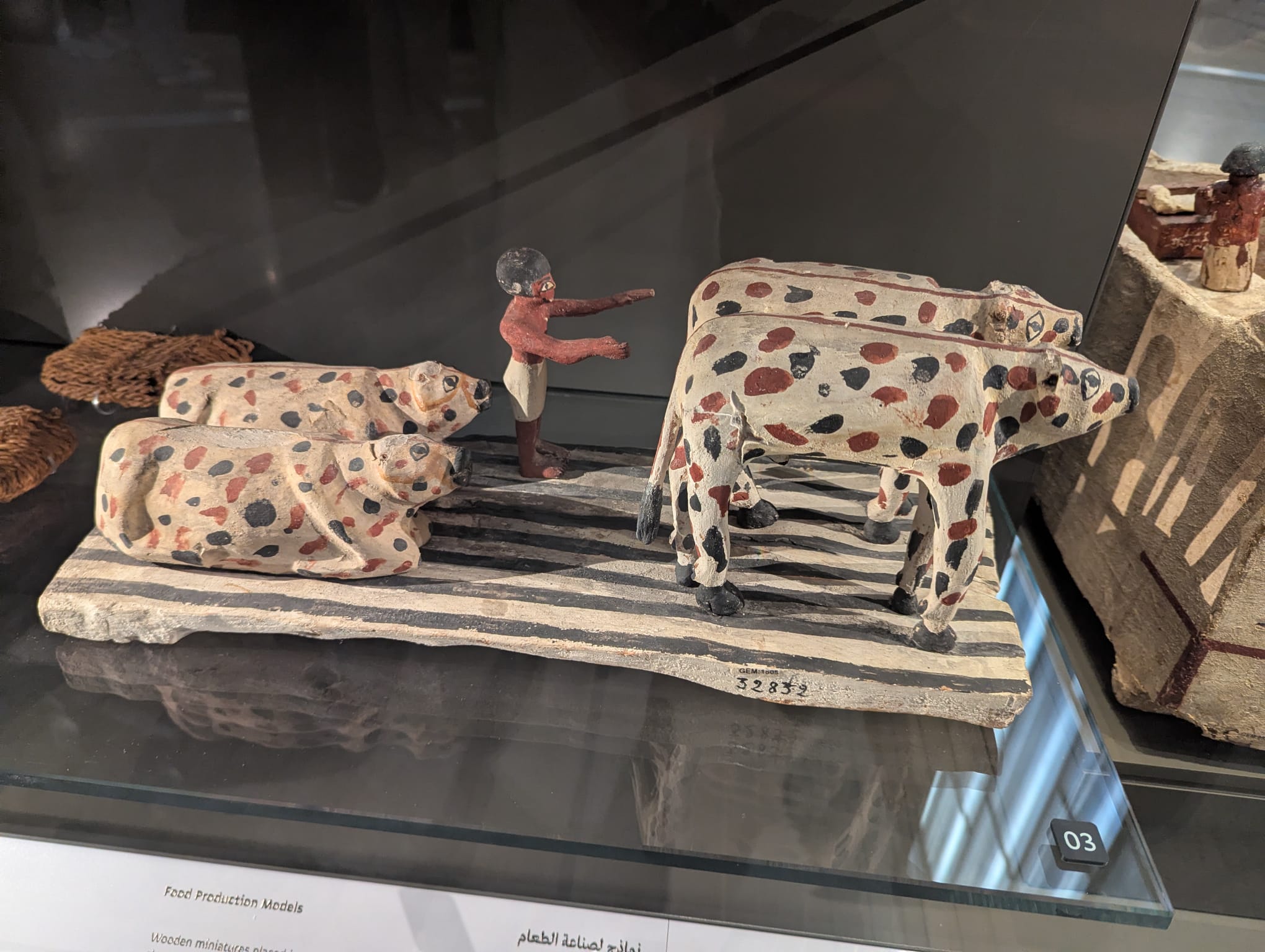
Cow miniatures
Cow miniatures


Of course, there is a danger here of romanticising the past. The harsh conditions of the desert was a constant threat to yields, with disease and famine a regular and unwelcome visitor. There’s evidence that Ancient Egypt was deeply hierarchical and sustained through forms of slave labour we would condemn today. But there is still something revealing in how closely agriculture, spirituality, ecology and community remained intertwined.

Modern tensions

But these ancient relationships between land, water and society would not remain untouched. Fast forward approximately 4,000 years and, like much of the world, the twentieth century brought immense change to Egypt’s social and agricultural systems.

Industrialisation and global markets reshaped production. Following land reforms and later economic liberalisation, farming systems shifted towards higher yielding crop varieties, synthetic fertilisers, pesticides and export-oriented production, particularly for crops like cotton. Population growth and rapid urbanisation placed increasing pressure on natural resources, with new towns built on fertile land bordering the Nile. The rhythms of the Nile itself were altered through damming and engineered control in the 1970s. The ancient flooding that once deposited fertile silt now also carries pollution.

Yet modern Egyptian farming continues to be shaped by an extraordinary (to the mind of a city-dwelling Brit, at least) geographical constraint: only around 4% of the country is considered fertile farmland. This creates a striking divide. Along the Nile Valley and Delta lie the “old lands” – ancient, intensely fertile soils that have supported civilisation for thousands of years, but are now under immense pressure from urban expansion, overcrowding and salinisation. Beyond them are the “new lands”: ambitious desert reclamation projects driven by government schemes and private investment, attempting to transform arid landscapes into productive farmland through irrigation, technology and infrastructure. Elsewhere, rainfed farming exists only in small pockets along the northern coast, used largely for grazing and livestock. Much of modern Egyptian agriculture therefore exists in tension between scarcity and expansion – between the ecological limits of the desert and the human ambition to push further into it.

These changes have also left agriculture occupying a somewhat contradictory social position. Farming work is frequently viewed as low-status labour, particularly among younger generations pursuing urban careers. While the 1970s saw parts of the British middle classes fantasise about “returning to the land”, many young Egyptians understandably preferred to leave rural hardship behind, although a growing agripreneur movement is now attempting to shift that perception through agri-tech, sustainable farming initiatives and food systems innovation.

“Much of modern Egyptian agriculture exists in tension between scarcity and expansion – between the ecological limits of the desert and the human ambition to push further into it.”

The effects of modernisation have also been felt keenly by those living at the margins of settled agriculture. Many nomadic and Bedouin communities, whose livelihoods were built around moving livestock through arid landscapes, have seen traditional ways of life reshaped by modern borders, tourism, settlement and economic change. Yet these cultures have not disappeared. While many Bedouin families have now settled in permanent villages and towns, often working in tourism and hospitality alongside pastoralism, it is still possible to glimpse herders moving goats, sheep and camels across stretches of land that conventional farming could never fully occupy. In a country defined by both ancient agricultural heritage and rapid modernisation, they remain a living connection to older ways of inhabiting the landscape.

Despite these profound changes, agriculture still quietly underpins Egyptian society and economy, employing around a quarter of the population and contributing significantly to food security and trade. Across Cairo, its persistence is visible in the city’s daily bread.

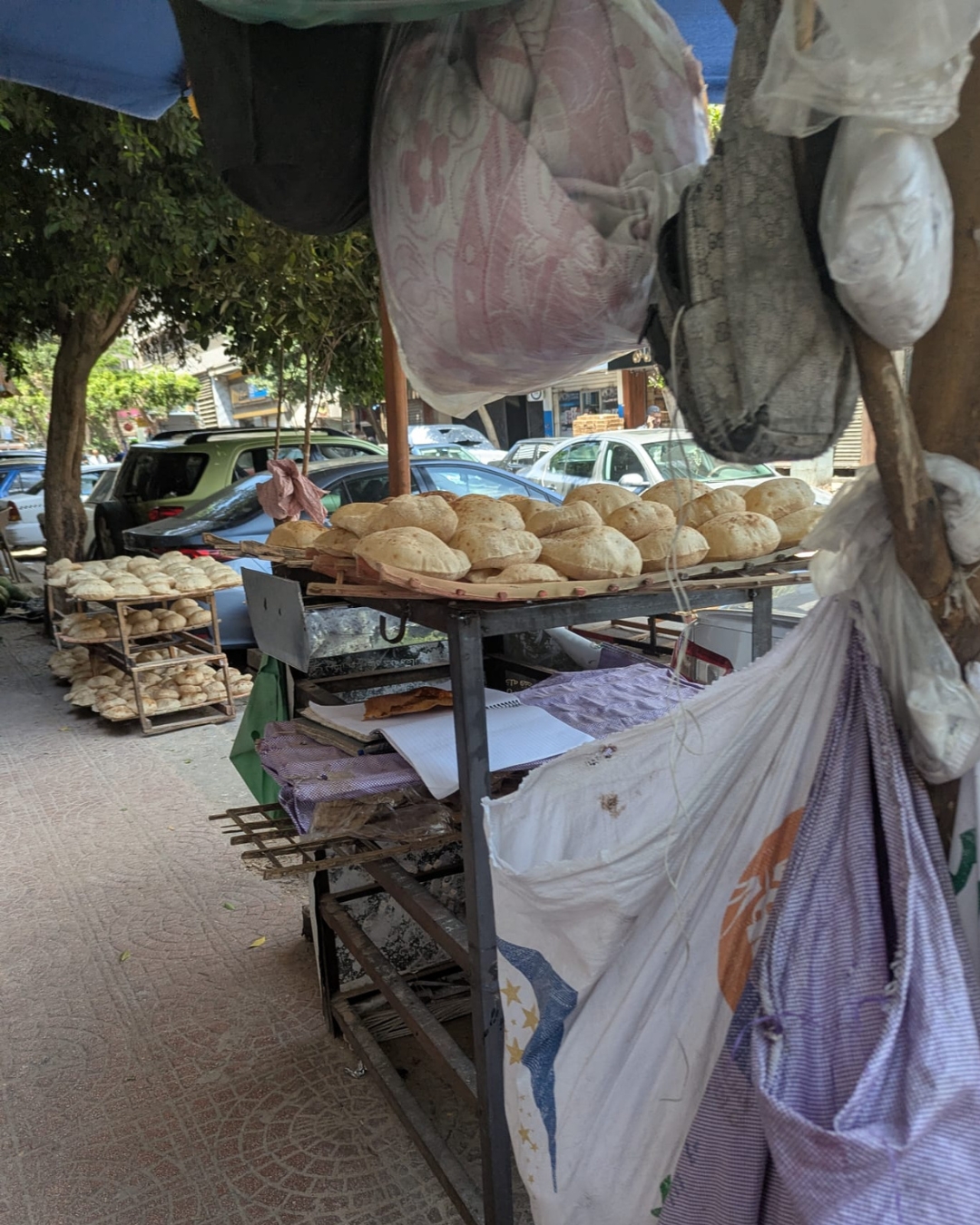
Loaves of bread (‘aish shamsi’) being sold on street markets


From dawn, markets and bakeries begin producing freshly baked ‘aish baladi’, a fermented wholewheat flatbread whose name translates to ‘bread of life’, is used to scoop or wrap everyday foods like ‘ful madamas’ (stewed fava beans), ‘ta’meya’ (falafel) and ‘bessara’ (similar to hummus). These are baked rapidly on heated conveyor belts and stacked high in woven trays. In rural areas, thick sourdough loaves such as ‘aish shamsi’ (‘sun bread’) are still proofed in the desert heat before being baked in clay ovens. In Cairo, the loaves are carried through the streets by vendors balancing them expertly on their heads or bicycles, a scene that still nods to practices depicted in Ancient Egyptian hieroglyphs (if you can look past the chorus of car horns).

A different vision

Against this backdrop of intensification, pressure and expansion, Dr Ibrahim Abouleish dug the first well in a stretch of desert that would later become SEKEM. Founded in 1977 after his return to Egypt from Austria, SEKEM began with a vision of regenerating desert land through biodynamic farming: a counterpoint to the growing momentum towards intensification, chemicals and industrial agriculture that was reshaping farming across much of the world.

Yet SEKEM was never intended to be simply a farm. From the outset, Dr Abouleish envisioned agriculture as the foundation for something much broader: a thriving social, cultural, economic and ecological ecosystem. Today, alongside agriculture, there sits a school, university, hospital, processing facilities, research centres and social enterprises, with profits from commercial enterprises being reinvested back into education, healthcare and the wider community. SEKEM’s vision is carried by thousands of farmers, educators, engineers, researchers, doctors and entrepreneurs, all working towards the development of the individual, society and the environment.

“SEKEM began with a vision of regenerating desert land through biodynamic farming: a counterpoint to the growing momentum towards intensification, chemicals and industrial agriculture that was reshaping farming across much of the world.”

Underlying this is a philosophy that repeatedly surfaced during my visit: that sustainability begins with love. At SEKEM, this is often described as an “economy of love” – the idea that healthy soils, thriving communities, meaningful work and successful businesses are not competing ambitions, but deeply interconnected ones.

Most mornings, Helmy Abouleish (Ibrahim’s son) gathers senior staff for a short circle. A mixture of Egyptian colleagues, German and other European expatriates, many switching effortlessly between Arabic, German and English, begin the day with light stretching, notices and SEKEM’s daily mantra: “Goodness of the heart, light of truth, love of the people.” What could easily be dismissed as symbolism instead appears throughout the organisation in practical ways. Workers are encouraged to pursue artistic practices and exercise during the working week, while university students study art and movement alongside technical disciplines. Conversations about spirituality and responsibility sit comfortably alongside discussions of composting systems, export logistics and groundwater monitoring.

There is also an interesting negotiation taking place between different worlds. German organisational precision meets laid-back Egyptian hospitality and Islamic traditions. Workers using modern technologies move between fields alongside oxen-drawn carts. Groundwater levels are monitored through WhatsApp photos, while ancient ideas about stewardship and shared responsibility remain embedded in the culture of the site.

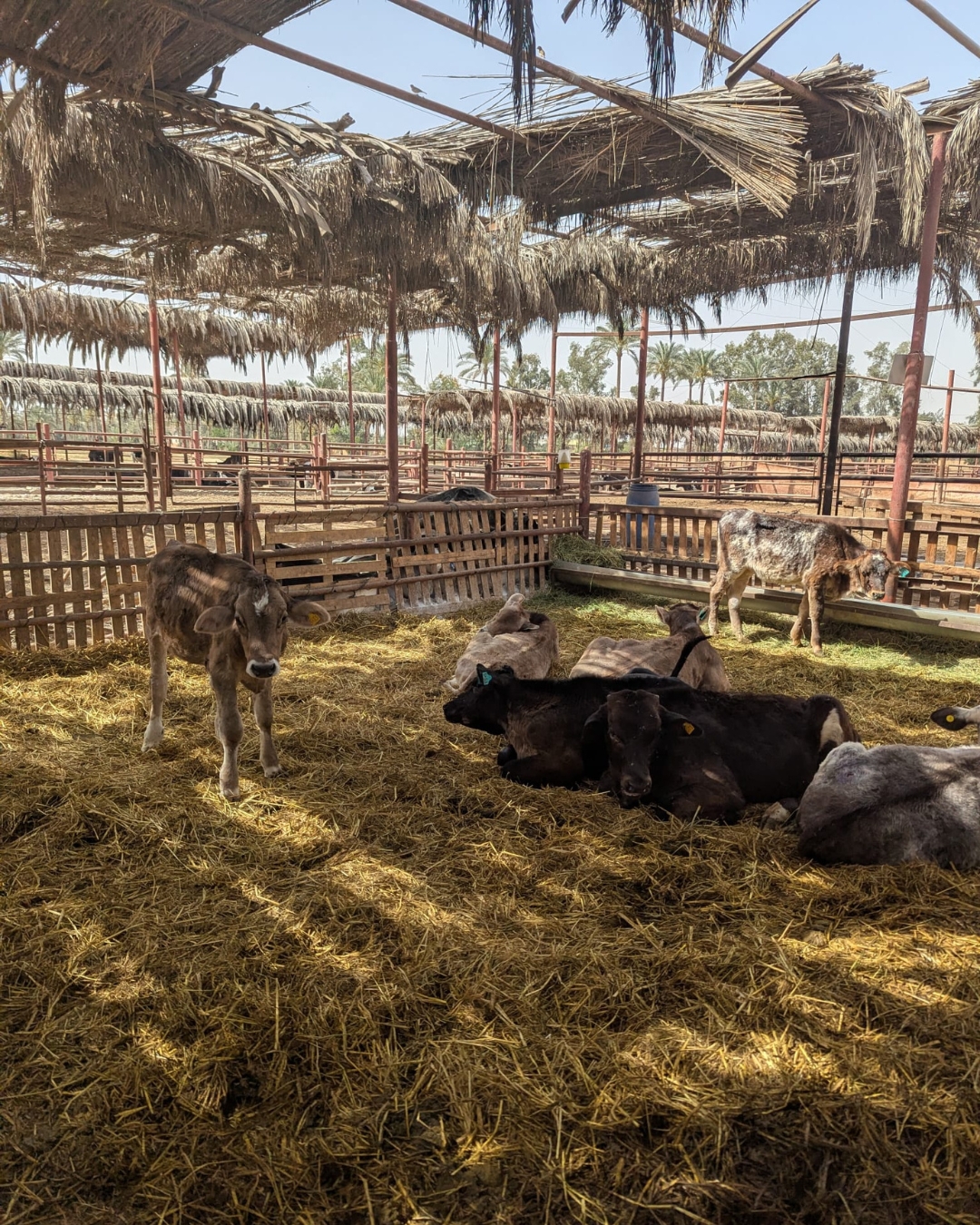
Livestock housing in SEKEM


Rooted in organic and biodynamic principles, SEKEM aims to work with ecological processes rather than against them. Yet some of the practices may surprise regeneratively minded farmers in the UK. The dairy cows are housed rather than grazed because the sandy soils cannot tolerate grazing pressure. Irrigation is constant, delivered through underground, trickle and sprinkler systems supplied by a mix of recycled and ground water. It seems water remains one of the project’s greatest vulnerabilities, with farming in the desert inevitably dependent on careful water management.

Perhaps that is exactly what makes SEKEM so interesting. Too often sustainability conversations present neat binaries: industrial versus regenerative, traditional versus modern, economic versus ecological. But real systems are messier than that. SEKEM does not feel like a perfect solution or a nostalgic return to the past. It feels more like an ongoing negotiation between desert constraints, cultural differences, modern pressures and alternative possibilities for the future of farming in Egypt.

Negotiating the future

Working on the Global Farm Metric has taught me that there is no single path to sustainability. The outcomes we seek may be similar, but the routes towards them differ enormously depending on culture, geography and history. What works in the British uplands does not necessarily work in the Egyptian desert.

After a long day, the sun sets on the Nile in Cairo


At SEKEM, sustainability appeared less as a checklist of metrics and more as a way of thinking about relationships. Still, measurement remains central. During an impassioned meeting at Heliopolis University, one question framed the discussion: “How do we measure love?”. And through its Economy of Love initiative, SEKEM supports tens of thousands of farmers across Egypt to reduce chemical dependency through training, knowledge exchange and financial incentives linked to carbon markets, while exploring how broader social and environmental benefits might also be recognised.

Yet spending time in Egypt left me reflecting on a bigger question than any metric could answer.

“Working on the Global Farm Metric has taught me that there is no single path to sustainability. The outcomes we seek may be similar, but the routes towards them differ enormously depending on culture, geography and history.”

What would life look like without projects like SEKEM? In a country facing increasing environmental pressure, pollution and social challenges that come from rapid urbanisation, projects like this act almost like beacons. Not because they offer a perfect blueprint, but because they suggest that alternative futures remain possible.

As Bedouin traditions adapt to modern realities, Egyptian agriculture continues evolving to modern challenges too. New technologies, markets and desert reclamation projects surface alongside older ideas about stewardship, spirituality and community. Whether SEKEM represents the future of Egyptian agriculture or simply one possible path through the desert, I’m not entirely sure.

But perhaps that uncertainty is what I found most interesting. Not the contrast between ancient and modern, but their coexistence. It reminded me that sustainability is probably less about returning backwards or accelerating forwards. It is not simply about reducing a system to set of metrics that can be scored and valued. It can be about deciding carefully which values are worth carrying with us, and allowing these aspirations to guide our work and fill us with hope for the future.


If you’d like to find out more about SEKEM and the work they’re doing to regenerate Egypt’s desert land, you can listen to this episode of the SFT Podcast, when our CEO, Patrick Holden, sat down with SEKEM CEO, Helmy Abouleish.

Graphic separator Graphic separator