What’s really in our food these days and how might it be affecting our health? In this conversation on the Sustainable Food Trust podcast, Patrick Holden, founder and CEO of the SFT, and Stuart Oates, founder of the Fossil Free Farm project, discuss what chemical residues and ultra-processed foods might mean for our health, and consider possible solutions.
Patrick:
Let’s discuss the influence of what we eat on our health. I’ve recently come across a couple of reports: the first was a retraction by a well-known journal that published a report, I think about 15–20 years ago, saying Roundup was safe. Last week, they retracted it because they realised that a lot of Monsanto employees had intervened and influenced the research, making it unsound. I think that’s big because Monsanto, and more recently Bayer, have been relying on that report.
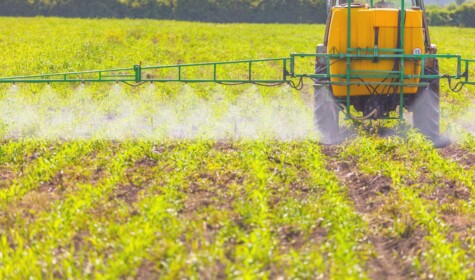
Roundup is widely used all over the UK and the world – on arable farms for weed control and as a pre-harvest desiccant, which is how it mainly gets into our food. Even if it breaks down quickly in the soil, it’s still on the crop at harvest. The first thing we should fix is that pre-harvest desiccant – that’s the biggest problem.
Stuart:
Yeah, you’re absolutely right. That pre-harvest desiccant is the biggest concern.
Patrick:
It ties into the broader conversation about chemicals in our food…and, as well as what’s applied to our food on the farm, there are also other kinds of chemicals in what we’re eating: the additives, the flavourings, all that stuff that’s put into food after it leaves the farm – particularly ultra-processed food.
There was a report in The Lancet recently looking at ultra-processed foods and other additives and the effect on the human microbiome. It sounds incredibly worrying. Basically, a lot of these additives are things our microbiome can’t cope with, and that’s almost certainly behind the exponential increase in previously uncommon diseases.
You have to ask why it is that one in two of us are now getting cancer. Surely that’s partly due to what we eat – and what we wouldn’t want to be in our food. I think The Lancet is drawing attention to that.
Stuart:
Yeah, absolutely. I think we’re only at the very beginning of that kind of research. For some reason, food has been completely unlinked from health for so long. I have lots of friends who are doctors, and not a single day of their course is spent on healthy eating and diet. That’s crazy.
That should be a big part of their training, because that’s preventative medicine – that’s what helps us live healthier lives along the way. Did you see the Panorama programme?
Patrick:
Yes.
Stuart:
That’s the next level. It’s looking at these forever chemicals.
Patrick:
That is quite scary.
Stuart:
Forever chemicals are going to be a big topic over the next decade. They’re only just being talked about in the mainstream, but they’ve been around for a very long time.
They’re deliberately designed not to break down. They have incredibly strong bonds, so they’re used for things like Teflon coatings on frying pans or waterproofing on jackets.
What shocked me in the Panorama programme was learning that there are forever chemicals in the sprays used on our food – pesticides and fungicides. They’re designed to stick to the surface of leaves and stay there. And that then gets into our food, our bloodstream, our bodies.
They’ve found forever chemicals in every single person they test. Every single one. You can’t understand how anyone thought that they were a good idea in the first place. Can you imagine, Patrick?
Patrick:
One chilling bit in that programme was when the presenter was offered a glass of red wine. Before asking if she wanted to drink it, the researcher explained that forever chemicals – which are active ingredients in pesticides – are sprayed onto grapes.
They explained that these chemicals are in the wine. Then they asked her if she still wanted to drink it. There was a grimace, and she said no. That was powerful.
I wonder whether red wine sales will drop this week – and whether organic red wine sales might rise. Because these issues really haven’t been brought to the public’s attention.
I don’t think the organic movement ever adequately described the extent to which unwanted chemicals get into our food and affect our health.
Stuart:
I think this is the big opportunity for organic. And we’re bound to say that, Patrick, as organic farmers and proponents of organic agriculture. But organic farming doesn’t allow forever chemicals – never has. That was part of the standards, even if we weren’t talking about forever chemicals when organic began.
If people really knew how their food was grown, things would change. I don’t want to attack other forms of agriculture – everyone is doing their best – but people need to know the truth so that standards and regulations can be higher.
In the UK, we’ll never compete globally on volume. But we could be the source of good, healthy, high-end food that’s environmentally responsible and careful about agricultural chemicals. We could be world leaders in that – if we choose to take the opportunity.
This extract is from an episode of the SFT podcast and has been lightly edited for readability. To hear the full conversation, click here. You can find all our episodes on the main podcast page.