Solutions for Local Slaughter: Small Abattoirs in Local Meat Supply Chains – Groundswell 2026
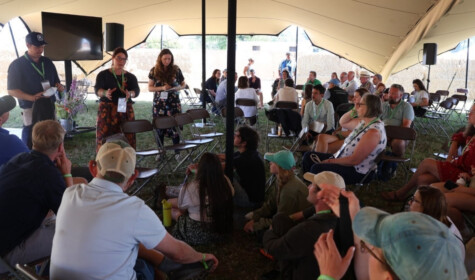
The Sustainable Food Trust organised a session at Groundswell 2026 – ‘Solutions for Local Slaughter: Small Abattoirs in Local Meat Supply Chains’. Chaired by SFT Head of Policy and Campaigns, Megan Perry, the panel featured experts from across the sector:
- Eleanor O’Brien, Managing Director of National Craft Butchers
- Kevin Maher, Head of Operations, Food Standards Agency (FSA)
- Claire White, Senior Veterinary Advisor, NFU
- Phil Gordon-Jones, Manager, Fir Farm
- Tom Bowling, Owner, Edge and Sons Abattoir
- Andy Gray, small/mobile abattoir consultant
The well-attended session involved break out groups for in depth discussion and questions with the speakers. The following anonymised summary brings together the key questions and discussion points made during these breakouts.
Summary
Setting up an abattoir
- How hard is it to achieve? Key challenges include financial viability, staffing and managing by-products and wastewater (see below for more detail). The question of how to finance a new project must be looked at closely and with legal advice as there can be issues surrounding this. Drawing on the expertise of those in the industry, including trade associations, consultants and the FSA, is crucial. Establishing that there is a clear need for the abattoir is also a critical first step. Deciding on the size of the abattoir will depend on demand, species, number and availability of slaughtermen and their capability.
- Economic factors to consider: Speakers made clear that an abattoir must run efficiently and that comes at a cost – the farmers who will use the abattoir must be prepared to pay full market value for the service, otherwise the abattoir simply won’t be viable. Running an abattoir is different from a farm business with its own core product. You must be prepared to work extremely hard. There are busy periods (autumn through to December, for instance) and quiet periods, and you need to keep the business ticking over through both.
Finance and business structure
- What type of business structure works best? That depends on your business model. If you are focused on community benefit rather than profit, a CIC is probably the structure you’re thinking of — there’s a regulator you’d need to apply to. It works well for some businesses, including some farm-based ones. Equally, a limited company with shareholders can work. There’s also a co-operative/mutual ownership model. It really comes down to your objectives, and taking independent financial and business advice is recommended, because there isn’t one straightforward answer. The NFU is worth mentioning too — beyond membership, they provide services, and there are some small funds available to support early feasibility work, which can help you through the early stages if cash is tight. There are also finance specialists such as Tim Field at Oxbury Bank who can help advise. Strict rules also govern how businesses can solicit investment from the public.
Funding
- Are any grants available? While the Smaller Abattoir Fund has now ceased, this was extremely beneficial and de-risked investment significantly – Andy Gray and Fir Farm both made good use of it. The Abattoir Sector Group are pushing for more funding to be made available in the future. Other potential options include the Levelling Up Fund, Farming Equipment and Technology Fund and Farming in Protected Landscapes (FiPL), which some groups are currently exploring.
Recruitment and training
- What are the issues with skilled labour? Training a competent slaughterman takes a long time (months to become basically competent, a couple of years to be fully proficient), and the sector faces recruitment and retention challenges. Apprenticeship schemes are being developed with industry training bodies to help address this. They need a temporary Certificate of Competence and license to slaughter. The challenge is getting people through the door in the first place (i.e. attracting people into the industry), the second issue is retaining the people you have spent time and money training.
Official Veterinarians
- How does official veterinary (OV) provision work for a small abattoir? Every red meat abattoir must have an OV present at all times when slaughtering, to deliver Official Controls (an inspection carried out by the vet and meat hygiene inspector). It’s rarely done through the local vet, as they need to be officially designated by the FSA to carry out the role. Historically, some local providers charged relatively high rates for this work; over the years, contracting arrangements have been modernised and consolidated, and prices have generally come down. There’s no fixed rota as such, but contracts are structured to provide cover, essentially, around the clock, and there is provision for subcontracting — so if your usual provider can’t attend, someone else meeting the necessary qualifications can step in. Recognising the right level of experience for this kind of work in a rural area, where caseloads can be quite different to elsewhere, is part of the challenge.
- Is there a vet shortage? There is not currently a shortage in vets in the way that was experienced during Covid and post-Brexit.
Regulation
- Can you say more about charges for Official Controls? There was a recent court case that’s given the FSA an opportunity to look again at how regulation and cost recovery for Official Controls is delivered proportionately. The FSA say they take seriously the principle that official controls and what they charge for them, should be fair and reflect what’s actually needed. It is worth being clear about roles: the FSA is the enforcement authority — they don’t set the underlying legislation. If people want to see the regulatory burden itself reduced, that is a matter for Defra and Ministers rather than the FSA. The FSA are often asked to explain and justify their own efficiency to ministers, which they do regularly.
- What about the alignment with EU regulation and the ‘5% rule’? A key discussion point was the EU-derived “low-throughput abattoir” derogation, which allows abattoirs to operate with reduced regulatory requirements (e.g. not needing an official vet present at all times), provided the combined throughput of such abattoirs doesn’t exceed 5% of national throughput. The UK has not historically been able to take advantage of this flexibility, and the sector has been lobbying for the 5% rule to be implemented in the UK. It would make a real difference for small abattoirs’ ability to grow and would give smaller operations flexibility to kill a bit more some years and a bit less in others, without immediately triggering the higher regulatory tier. The EU itself has reportedly been looking at raising its own threshold towards 10%, partly because they want the small-abattoir sector to grow. As the sector has consolidated, the abattoirs that remain could in principle do more, but the regulatory burden constrains that. It also affects related services — for example, private-kill services for farmers tend to be the first thing an abattoir stops offering when under pressure, which particularly hurts smaller producers who rely on it.
- Is there any prospect of a specific small-scale, low-volume allowance to be processed without full regulation? There’s discussion of something along those lines — comparable to arrangements in some European countries — allowing a small, defined number of animals (for example, a modest number of sheep) to be processed locally under a lighter regime. It hasn’t been secured here yet, but it is part of the broader conversation. The rationale for the current system is that approved slaughterhouses guarantee proper checks — animal health and food safety — and there’s understandable caution about diluting that as more processing moves on-farm.
- What about the potential for remote inspection technology and AI in reducing the amount of official veterinary time required on-site? It’s an interesting area, and one that is being discussed. It is possible that if more abattoirs are built in remote areas, this will make camera-based inspection more appealing, so infrastructure and appetite may end up developing hand-in-hand. However it is, of course, important not to compromise on standards while developing these technologies.
Mobile Abattoirs
- How mobile are they? Mobile units are, in reality, only as mobile as their hubs or licensed sites enable them to be. Mobile units still need to be licensed in the same way as a static abattoir, and each site the unit goes to also needs to be separately licensed and have the correct facilities, which can make being truly mobile a challenge. However, the new Orkney Tiny Trailer Abattoir (TTA) will likely be more mobile than previous models as it is smaller and primarily for sheep only.
- More about the hub concept: Orkney will be using hubs – sites that are licensed and have the correct lairage that the mobile unit will dock into. This can be simplified so that existing infrastructure such as sheds, toilets and offices (needed for vets) can be used. Water collection can be done with an IBC. Scottish government (Food Standards Scotland) have tended to be more relaxed than England.
- How long does it take to build? The time taken to establish a mobile abattoir varies depending on several factors including location, design, availability of parts and engineers, funding and project management. Fir Farm’s Mobile Slaughter Unit took 18 months for the initial unit to be built.
- How much does it cost? The Orkney TTA cost £100k, Isles of Scilly will cost around £200k and the Fir Farm unit cost £240k – but more was spent on lairage, chiller, etc. More funding for infrastructure is needed. Running costs vary but Fir Farm costs around £1,500 per kill day.
- What happens to waste and by-products? This is context specific and varies a lot. For example, Fir Farm waste is currently going as category 1 at 50p per kilo. Andy Gray is developing a fertiliser business that can utilise waste. On the Scilly Isles new sewage treatment works are being built which will be helpful for managing waste water from the abattoir unit being constructed there. At Fir Farm, underground pits are used to store the hides, which go to a local tannery. Hides and skins are a major challenge, but there are people working to revive small-scale traceable tanning in the UK, such as British Pasture Leather, which may provide more opportunities in the future.
- Do you need a vet? Yes, all red meat abattoirs, including mobiles, require an Official Veterinarian to deliver Official Controls.
- Can you get a return on capital when being run at capacity? This is unlikely but depends on throughput and hanging capacity.
- What are the regulatory issues of a mobile unit? Mobile units are regulated in the same way as static abattoirs. There is a difference between a fully mobile abattoir (like the TTA) and a mobile slaughter unit (like Fir Farm) – you will also need to think about regulation around butchery services, lairage, etc. Planning permission for lairage and a cutting room on-farm can be easier to achieve first, rather than an abattoir.
Casualty and emergency slaughter:
- What are the options for using meat from emergency or casualty slaughter? For casualty slaughter of fractious or dangerous animals — for example, difficult cattle or buffalo — there is a recognised route: the animal is shot in the field, then winched onto a trailer or into a box for transport to the abattoir within the required time window (two hours). Because the animal is shot and bled promptly, there is very little compromise to the carcase. Many slaughterhouses already have the facilities to receive casualty animals killed this way. It is important to note that this route is for acute injury or an accident — it can’t be used for a chronic condition such as long-standing arthritis; the animal must be genuinely unfit to travel due to an acute event.
- Is there any prospect of extending this to animals in the field with more general acute welfare needs? There is an ongoing conversation about broadening the ability to shoot animals in the field in a wider range of acute situations, since it is arguably a considerably better welfare outcome for the animal than transport followed by conventional slaughter — even accounting for how things look from the outside.
Poultry and game slaughter
- What are the regulations around on-farm poultry slaughter? Farmers can slaughter poultry on their own farm without a licence provided they stay within set thresholds (up to roughly 150,000 birds per year), and without needing veterinary supervision. Selling the meat, however, requires registration with the local authority, inspection of facilities, and evidence of appropriate training. Red meat does not currently benefit from an equivalent on-farm derogation. Game handling establishments operate under a different (somewhat more relaxed, but still regulated) set of rules to conventional abattoirs. Wild game such as shot squirrels or rabbits generally needs to go to an approved game-handling establishment rather than directly to a restaurant.
- How does the regulation work for game — for example, squirrels or rabbits shot on my own land? If you’re operating as an approved game-handling establishment, there are a fair number of derogations in place compared with standard abattoir rules — particularly around fur and feather game destined for local butchers. Local authorities generally have good, longstanding working relationships in this area, and the rules — while still rules — tend to be more relaxed, for example around inspection of shot game for signs of the shot itself.
North Cotswold Abattoir
- Will it serve only the local private kill market? No, North Cotswold Abattoir is aiming to do more than private kill. Their key challenge is ensuring market/slaughter prices work for farmers and supply chain.
- How are you setting up the structure for the Cotswold Abattoir? We have three directors and shareholders with equity shares.
- What financial advice can you give? There are two types of tax relief you can look into – 30% and 50%. It is illegal to solicit investment directly, so people looking to invest must come to them directly via the website. They’ve had 400 expressions of interest from a spectrum of people including local farmers and bigger investors.
For more information on setting up an abattoir, take a look at the ‘Playbook’ put together by Claire White which can be found on the Abattoir Sector Group’s website – ‘Small Abattoir Development Support’.