Lebanon is facing a food security crisis. An over reliance on imports at the expense of investment in local food networks and sustainable domestic agriculture, has left the country vulnerable in the face of acute shocks. As conflict and climate change cause increasing turmoil and food security rises up the global agenda, Zeead Yaghi – scholar, writer and editor – explores why Lebanon is at such severe risk of food shortages and the lessons that can be learned.
Three weeks into the latest Israeli war on Lebanon, the second in as many years, its bombing campaign has unleashed a devastating humanitarian crisis. Over one million people from south Lebanon and the southern suburbs of Beirut have been displaced, and roughly 20% of the entire population have been pushed into emergency refugee centers.
Some refugees with enough means have opted to find housing on the private rental market, but the price shock driven by increased demand and sectarian anxiety over the displaced has left many unable to afford such alternatives. This has left tens of thousands of displaced people without any shelter and no recourse but to sleep rough on the available public spaces in the capital: the seaside corniche in Ras Beirut facing the Mediterranean, large sidewalks in downtown and the small scattered few parks across the city.
“Prior to the start of this war, Lebanon was already undergoing a severe food security crisis. Recent assessments by the Integrated Food Security Phase Classification (IPC) estimate that around 1.26 million individuals are facing crisis-level food insecurity (Phase 3), including approximately 85,000 in emergency conditions (Phase 4)…”.
Emergency relief efforts by the Lebanese government, local mutual aid networks and international organisations provide the displaced with shelter, medicine and especially food. This is occurring within the backdrop of Lebanon, which has undergone a series of economic and political crises that have undermined its already fragile and precarious food sovereignty and security systems.
Prior to the start of this war, Lebanon was already undergoing a severe food security crisis. Recent assessments by the Integrated Food Security Phase Classification (IPC) estimate that around 1.26 million individuals are facing crisis-level food insecurity (Phase 3), including approximately 85,000 in emergency conditions (Phase 4), highlighting the urgent need for humanitarian intervention. Refugee populations are particularly vulnerable, with significant proportions of Syrian and Palestinian refugees experiencing acute levels of food insecurity. In response to worsening economic conditions, displacement and conflict, the Food and Agriculture Organization (FAO) and the World Food Program (WFP) have identified Lebanon as a major hotspot of concern globally.
This brings us back to the current moment.
Lebanon depends on imports to provide roughly 80% of its food needs. This model works as long as the global supply chain that provides the transport of food resources to the country, stays intact. Currently, the Israeli government has refrained from bombing the Lebanese International Airport and the Port of Beirut, the main arteries for food supply into the country. Should Israel strike these two sites, as it did in the early days of the 2006 war, rendering them inoperable, the country could stand to face a major food catastrophe.
Other geopolitical circumstances also threaten this fragile food system. The Israeli war on Lebanon is partly an extension of the current American/Israeli war on Iran that has shut down the Strait of Hormuz, all but blocking the transfer of oil, natural gas and fertiliser out of Persian Gulf states to the rest of the world. This has had the immediate cost of increasing the prices of these commodities across the world, and countries dependent on the oil from the region have begun to ration resources in anticipation of price shocks and further delays. The cascading effect of the blockade on the supply chain is the gradual increase in cost of transportations of material, not only oil and gas, but all supplies transported across the globe to astronomical prices, whose costs will be borne by the poorest nations and people across the globe.
“Currently, the Israeli government has refrained from bombing the Lebanese International Airport and the Port of Beirut, the main arteries for food supply into the country. Should Israel strike these two sites, as it did in the early days of the 2006 war, rendering them inoperable, the country could stand to face a major food catastrophe.”
Lebanon is already seven years into a large-scale financial crisis, engineered by its oligarchic elites, which liquidated the savings of the majority of the country and decimated the value of its national currency. The crisis pushed 44% of the current population into poverty according to a 2024 report by the World Bank, as well as driving the costs of everyday necessities into hyperinflation. Since the resumption of the fighting in Lebanon, food prices have gone up quickly in a matter of weeks, with foods like bananas jumping 41%, while the price of lamb has increased by 21%.
One week into the war, the Lebanese Minister of the Economy and Trade, Amer Bisat, reassured the residents that the country had high-level storage of basic commodities in flour, food and gas, insisting that food security was “safe for several months”. But that was early into the war and the situation, both in Lebanon and the Persian Gulf, have escalated quickly with no end in sight.
“Since the resumption of the fighting in Lebanon, food prices have gone up quickly in a matter of weeks, with foods like bananas jumping 41%, while the price of lamb has increased by 21%.”
Hani Bohsali, the head of an all-powerful food import syndicate, told local television on March 23rd that although fuel costs have risen by 40%, it has only so far been reflected in a minimal raise in local food prices, nothing “above 5%”. There are, however, no guarantees that food importers will not use the opportunity to price gouge local consumers and drive an already anxious and destitute population into further poverty. The government has, so far, only paid lip service to a monitoring role to prevent importers from abusing their leverage, yet we have not seen any significant action towards that role.
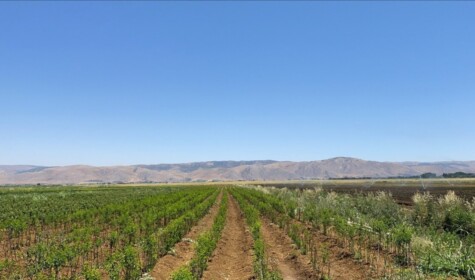
Meanwhile, the Israeli onslaught continues to devastate the country’s natural resources. The Israeli bombing campaigns of 2024 and 2026, the use of white phosphorus, and targeting of agricultural fields in both southern and eastern Lebanon have destroyed and polluted precious important agrarian land which will take years to recover. Last February, Israeli drones sprayed pesticides over agricultural fields in southern Lebanon, and tests reveal the substance was glyphosate which destroys vegetation and poisons the soil. The purpose of Israel’s ecocide in these parts of the country is to both unravel the local economy and ecology of the region making it uninhabitable to its residents. Israel seeks to create a depopulated buffer 15 km into Lebanon up until the Litani river. By rendering the land unlivable this objective becomes easier. On March 15th an Israeli strike on the border of Chebaa in southern Lebanon killed two shepherds.
The immediate and historical circumstances of war, financial collapse and political deadlock, paint a dire picture for Lebanon’s food sovereignty and future food security. Unless there is an immediate cessation of hostilities which allows displaced people back to their homes and the implementation of a massive humanitarian relief campaign, the civilian population stands to lose most. Once, and if, the fighting is over, unless Lebanese officials implement structural changes to agricultural and economic policies that shift the country’s food regime away from import dependence towards resilient agroecological and sustainable systems, we are bound to find ourselves in similar predicaments many more times in the future whenever a geopolitical crisis erupts.
Featured image by Diana Salloum.