Members of the SFT team share some of their top food and farming reads for 2025.
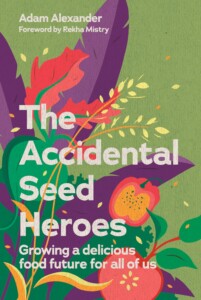 The Accidental Seed Heroes: Growing a Delicious Food Future for All of Us
Author: Adam Alexander; Publisher: Chelsea Green
Reviewed by Amy Warner
Adam Alexander’s The Accidental Seed Heroes is a powerful and timely exploration of the quiet revolution reshaping the future of our food. He embarks on a global journey to uncover the individuals and communities who are saving, breeding and innovating seeds outside the grip of industrial agriculture.
At the heart of the book lies a simple but radical premise: that every grower, from backyard gardener to traditional farmer, has the potential to be a “seed hero”. Through vivid storytelling and immersive reportage, Alexander introduces us to an inspiring cast of twenty-first-century plant breeders from places as varied as southern Albania, Ethiopia’s Great Rift Valley, rural India, and his own garden in Wales. These are individuals who understand that biodiversity, flavour and adaptability are not luxuries but necessities in the face of a climate crisis and corporate control of seed stock. He also delves into the fascinating genetic lineage of different cultivars, how they developed in popularity and became so dominant in global production for better or, in some cases, for worse.
Alexander’s style is equal parts investigative and affectionate. He blends scientific rigor with enthusiasm as he explains plant breeding techniques both ancient and modern, from phenotype selection to genome editing and marker-assisted selection.
What makes The Accidental Seed Heroes especially engaging is its political urgency. Alexander pulls no punches in exposing the dangers of seed patenting, corporate monopolies and the commodification of food. He critiques a global system that marginalises traditional knowledge and breeds genetic homogeneity at the expense of resilience. But he does so with a hopeful spirit, arguing that alternative systems – rooted in open-source breeding, farmer-led innovation and public good – are not only possible but already thriving in small pockets around the globe.
Whether you’re a seasoned grower, a food systems advocate or simply a curious reader concerned about the future of what we eat, The Accidental Seed Heroes will inspire, educate and move you. It’s not just a book about seeds – it’s a manifesto for food sovereignty, biodiversity and ecological justice.
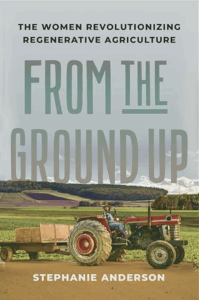
From the Ground Up: The Women Revolutionising Regenerative Agriculture
Author: Stephanie Anderson; Publisher: The New Press
Reviewed by Alice Frost
Stephanie Anderson’s From the Ground Up explores the roles of 13 different women across the US – from California to North Carolina – unknown to one another but connected by their commitment to transforming America’s food and farming systems for the better.
From the Ground Up is divided into eight chapters, each of which sees Anderson visit a woman or group of women who have a role to play in the regenerative agriculture transition. In South Dakota, Kelsey Scott, a fourth-generation rancher and descendent of the Lakota Nation, practices regenerative rotational grazing in an effort to transform the drought-ridden prairie lands. Meanwhile, in San Francisco, Bu Nygrens, Mary Jane Evans and Karen Salinger are heading up Veritable Vegetable, a regional food hub which supplies consumers with a diverse produce list of various fruits and vegetables, courtesy of a diverse growers’ network. We also meet the women who are working as outreach workers to support farmers who are beginning to transition to more regenerative methods, and the women who are sourcing investment to finance this transition, along with those who are pedalling the policy to take it to scale.
It’s 2022 when Anderson meets the women of From the Ground Up – at the same time, the Supreme Court draft decision to overturn Roe v. Wade is leaked, a shocking moment in American history. It’s a stark – if not rather unpleasant – reminder that makes this book feel all the more urgent and necessary reading, to hear from the women who refuse to be held down and turned away. Anderson explains how the ruling motivated her that much more to write the book: “The part of me feeling low needs to witness this kind of strength right now … [the need] to hear from women who thrived in harsher circumstances than my generation faces.”
Each of the women in this book are rejecting the idea of what the modern American farmer, food distributor, executive or policymaker should look like. Not only are they women attempting to break the mould, but they’re also women of colour, they’re queer women, women from marginalised communities who aren’t often given a seat at the table. Their presence in a traditionally male-dominated field will embolden others to participate and make sure their voice is heard, and as Bu Nygrens puts it “It’s not enough to criticise the paradigm. You have to be the thing that you want to replace the paradigm with.”
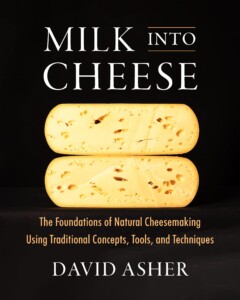
Milk into Cheese: The Foundations of Natural Cheesemaking Using Traditional Concepts, Tools, and Techniques
Author: David Asher; Publisher: Chelsea Green / Rizzoli
Reviewed by Rachel Kehoe
Milk into Cheese is more than a cheesemaking manual – it’s a meditation on our relationship with milk, tradition and time. With the authority of someone who has lived the process, David Asher guides readers through the rhythms of nature, dairy and fermentation.
Structured in three parts, the book blends history, culture, microbiology, chemistry and culinary technique. It invites us to question the assumptions of the modern dairy industry – its reliance on pasteurisation, refrigeration and industrial production – and instead rediscover the slower, more intentional craft of traditional cheesemaking. From sourcing milk to aging wheels, every step is explored in detail, with practical advice and troubleshooting throughout.
Asher opens boldly: “Here I am in France, teaching the French how to make cheese.” As the book unfolds, his deep knowledge and lived experience shines through, and you begin to see why. His ethos is clear – a return to a more grounded, artisanal way of working with milk. He paints vivid scenes of a time when cheese was made twice daily, not for novelty but for necessity, and milk was treated as the precious, living food it is.
Though centred on cheese, the final section branches out into recipes for other cultured staples – cultured butter, sourdough bread, wine, cider and the caramelised Slavic yogurt ‘ryazhenka’. These additions make the book both an inspiring read and a practical kitchen companion.
Whether or not you plan to age your own Comté, Milk into Cheese will likely change the way you see dairy – and may just have you dusting off that yogurt pot.
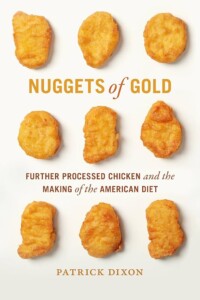
Nuggets of Gold: Further Processed Chicken and the Making of the American Diet
Author: Patrick Dixon; Publisher: University of Georgia Press
Reviewed by Imogen Crossland
Nuggets of Gold tells the story of one of America’s most loved – and most controversial – foods: the chicken nugget. Without casting heavy judgment, Patrick Dixon examines the political, social and economic forces that helped processed chicken become a staple of the American diet.
In the 1930s, US farmers rarely kept more than 200 chickens, often as a side venture to make use of the farm’s by-products. But after the Great Depression, as farmers sought new, more prosperous income streams, feed mills and agribusinesses seized the opportunity to expand production. A World War II campaign urged Americans to “Eat more poultry and conserve beef and pork for the armed forces,” propelling chicken to become a mainstream meat. Within a few decades, millions of chickens were being processed annually, accompanied by a host of ecological, social and animal welfare consequences.
Dixon sheds particular light on the inner workings of poultry processing plants – an industry largely hidden from public view. While the demographics of poultry workers have shifted over time, working conditions have, shockingly, changed very little – it remains a low-paid job with a heavy physical and emotional toll. Dixon also points out that animal welfare concerns rarely extend beyond the farm gate and into the “hidden realm of the abattoir”. It’s a stark reminder that these are issues which should be central to conversations about the future of livestock production.
The nugget made its official debut (as the McNugget) in 1983. Positioned as a lighter, healthier alternative to the beef burger, its popularity soared in an era of cost-cutting and weight-watching. One question that springs to mind is whether the rise of the nugget (and its further processed cousins) can be attributed solely to consumer demand for such products, or whether corporate sales strategies and aggressive marketing played a greater role. As one former Taco Bell CEO put it: “We’re really not in the business of making food. We’re in the business of feeding people.”
What Dixon leaves to the imagination is where we go from here: will industrial chicken nuggets persist for another 50 years? Will they be replaced by lab-grown alternatives? And what about the health and wellbeing of the chickens, the workers and the people who eat them?
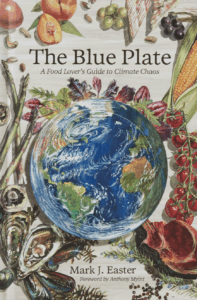
The Blue Plate: A Food Lover’s Guide to Climate Chaos
Author: Mark J. Easter; Publisher: Patagonia
Reviewed by Alicia Miller
The Blue Plate by Mark J. Easter is part odyssey, part exploration and part a search for answers. Its premise is a simple one – Easter asks “Can we transform agriculture from a system that literally consumes the planet to one that nurtures and respects this home that is all we will ever know? Can we cultivate from the Earth meals that nourish us, a Blue Plate of sorts, rather than the Earth being the meal itself?”
Easter is an ecologist who comes to the table wanting to find answers to this simple set of questions. He also likes his food and wants to understand better how we can create a more sustainable food system as we move towards the impending climate chaos we are all beginning to witness. Agriculture is at the heart of his quest, and he seeks to banish the industrialised food system that is wreaking havoc across the globe.
For Easter, it is a journey through past practices that have been renewed and sometimes reinvented. “Growing cover crops to feed the soil, preventing erosion, feeding livestock on pastures integrated with food crops, composting food waste and livestock manure to cycle nutrients back onto fields and pastures, and purchasing from one’s local ‘foodshed’ all were common-sense aspects of agriculture in times past,” comments Easter. These practices are focused on ‘drawdown’, locking up our emissions in our soils, leaving them undisturbed and on top, utilising cover crops, composting and the wonders of grazing livestock. There is much promise in the regenerative practices that more and more farmers are adopting, especially in the US, and change could make all the difference.
How do we end the burning of fossil fuels? We are a long way off still from realising this, but reworking our food system could offer a meaningful way forward towards a better world. The book ends with some simple suggestions: keep carbon in the soil and minimise tillage; bring our food closer to home; take care of our rivers and seas and don’t fly fish and other food around the world; finally, compost as much as you can.
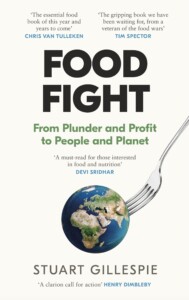
Food Fight: From Plunder and Profit to People and Planet
Author: Stuart Gillespie; Publisher: Canongate
Reviewed by Mali Gravell
Food Fight is the latest contribution from global nutrition expert Stuart Gillespie. Gillespie’s global experience, rooted in decades of work on nutrition shines through this powerful read. It provides an eloquent overview of the modern, global food system and takes the reader through the transition of the food system from its colonial roots through to the current era of corporate dominance.
The first parts of the book – titled ‘Cascade’ and ‘Regime’ – chronicle the journey of the food system to one which is dominated by profit maximisation leading to widespread malnutrition, obesity and environmental degradation. It reiterates that the current food system is not broken; it is functioning as it has been designed to – enabling a few to make large profits. It is not focused on nurturing people or planet. The book takes the reader through an assessment of where and why the system is failing, providing a deep diagnosis of the structural issues, laced with on-the-ground examples from individuals and organisations across the globe.
Food Fight provides a unique blend of realism and hope – the urgency of the situation is made clear but the opportunity for hope leaves you feeling slightly daunted. Real world solutions that are already in action are highlighted alongside personal stories of successful change. Although published amidst a proliferation of food system narratives in recent years, this felt like another piece of the puzzle rather than a re-writing of the same story.
For anyone interested in health, nutrition, climate, sustainability and social justice, this book provides a thorough overview of where our food system is now and of the deep and systemic changes required to shift our food system back into balance
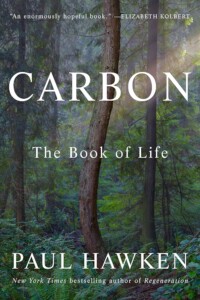
Carbon: The Book of Life
Author: Paul Hawken; Publisher: Viking Press USA
Reviewed by Alicia Miller
Paul Hawken’s book Carbon: The Book of Life is a call to all of us to sit up and pay attention to what is happening to our planet and all that lives on it. We are in the midst of a world that is at risk in every way imaginable and most of us are looking the other way and pretending not to notice. In the opening paragraph, Hawken reminds us that “Carbon’s increase in the atmosphere moves in tandem with the loss of the living world.” And that loss, if it is left untended will be our demise. It’s a stark warning.
Carbon, says Hawken, is “a window into the entirety of life”, and through the book, he follows the strands of carbon. He explores the early investigations into climate change as it arose in the 19th century, through the prescient studies of scientists who began to think the climate was warming. “Humankind,” Hawken writes, “created a new geological era by burning ten billion years of fossilised carbon in a few centuries.” Here in the 21st century, we are faced with the consequences, but the problem is that “Most of humanity doesn’t talk about climate change because we don’t know what to say.”
Carbon, Hawken tells us, is “the keystone element of sentience”. But biology is more complicated than we think, and Carbon illustrates some of the complications of ‘life’, more broadly. For starters, biologists have ceased to define what it is, leaving its finality still waiting at the door. There are infinitesimal beings like the tardigrade and rotifers that can survive in ways unimaginable to other lifeforms – reanimating themselves with a bit of water after decades or even millennia. These are wonders to behold!
Hawken tells both extraordinary and terrifying stories – his description of the ongoing decline of insects that will lead to the end of the planet if our attitude towards bugs doesn’t change, is just one of them. Hawken begs for a more caring world that encompasses all of life, not just human life, and begs us to see sentience not only in ourselves.
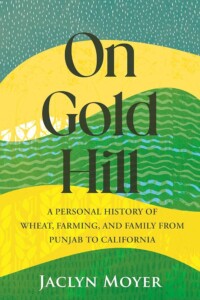
On Gold Hill: A Personal History of Wheat, Farming, and Family, from Punjab to California
Author: Jaclyn Moyer; Publisher: Penguin Random House
Reviewed by Isabel Eaton
Writer and organic grower, Jaclyn Moyer grew up in California, distanced both geographically and culturally from her family’s roots in the Punjab region of India. Unable to speak the language of her grandparents and with few insights into the shape of their lives prior to their move to the US in the 1970s, she arrives in her mid-twenties increasingly troubled by this disconnection from her ancestry.
However, when she and her partner Ryan take on the tenure of an organic small holding in Gold Hill, California in 2012, the land provides an unexpected opportunity to explore her family’s past. Through the growing of Sonora wheat, a landrace grain once commonly produced in California and whose origins can be traced back to Punjab, Moyer begins to form an ever-closer connection with her heritage, culminating in a visit to the village where her grandmother grew up.
Combining an honest and personal account of the challenges of running an organic farm with insights into the turbulent history of her family, and an exploration of the impacts of the Green Revolution, US international food policy and the organic movement on food systems in India, the US and beyond, on the surface On Gold Hill may appear to be covering rather a lot of ground. But Moyer cleverly weaves all these elements together into a cohesive debut book, which is touching, eye opening and well worth a read.
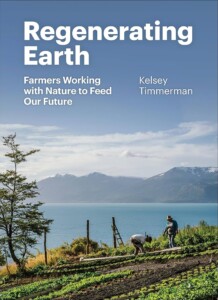 Regenerating Earth: Farmers Working with Nature to Feed Our Future
Author: Kelsey Timmerman; Publisher: Patagonia
Reviewed by Victoria Halliday
Regenerating Earth takes us on a global journey to visit some of the world’s most inspiring farms and rural communities. Coming from a long lineage of farmers and prompted by his own move to a smallholding in Indiana, author Kelsey Timmerman sought to deepen his understanding of how farming can rebuild our health, our sense of belonging and the planet’s ecosystems.
Timmerman’s home is surrounded by industrial agriculture – seemingly endless stretches of single crops that depend on vast amounts of agrichemicals, water and oil. It is a form of farming that is squeezing out many smaller and medium sized producers, while also damaging the environment and feeding the centralised, ultra-processed food system that is undermining our health. Timmerman emphasises that it isn’t farmers who should be blamed for this – they include his friends and family, many of whom are at the frontline when it comes to bearing the ill-effects.
Resolving not to succumb to despondency, Timmerman sets off on a journey that sees him visit regenerative farms in the US, agroforestry operations in Brazil and the cattle herding communities of Kenya. He seeks to uncover the universal principles that underpin a regenerative approach to farming, while sharing the very human stories of the people behind these places – people who often fiercely battle corporate interests in order to protect their way of life and enjoy a more connected existence.
While ‘regenerative’ has become a popular buzzword of late, Timmerman reminds us, “Regenerative agriculture isn’t an exciting new thing. It’s an exciting old thing. As it’s been practiced by Indigenous people for thousands of years, it’s not centered on extraction but on relationships with the natural world; it is not just about farming, but our relationships with science and technology, each other, and ourselves.” Through a mix of first-hand conversations, thoughtful reflections and photography, Regenerating Earth combines the practical and the philosophical to show how we can embrace a more joyful way of living, farming and eating – not just in the future, but in the here-and-now.
More books for your shelf…
Hawa Hassan
“An enthralling, intimate collection of essays and over 75 recipes exploring the history of eight countries to understand the impact of geopolitical conflict and its outcomes on cuisine and food system, from Somali refugee and James Beard Award-winning author of In Bibi’s Kitchen.”
Banana Capital: Stories, Science, and Poison at the Equator
Ben Brisbois
“An urgent call to action, unveiling the power dynamics of life in the banana industry. Ultimately, the book provides a roadmap toward social justice and sustainability in the uncertain future of banana production.”