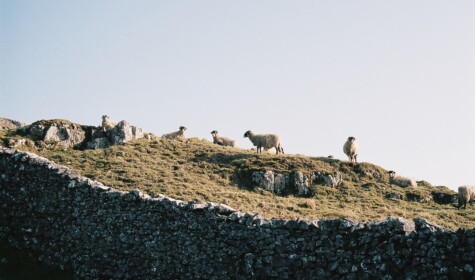
As tensions rise over how the UK’s uplands are managed, the SFT’s Senior Research Manager, Robert Barbour, considers how we can build a more constructive conversation about their future.
A recent legal challenge brought to the High Court by campaign group Wild Justice has re-ignited one of the more interminable debates around land use – the role of sheep in the UK’s uplands.
Wild Justice’s argument was that the Dartmoor Commoners’ Council is failing to meet its statutory obligations to protect the moorland environment, by refusing to reduce livestock numbers. This led to the publication of two articles in The Guardian – one, an opinion piece by Chris Packham, the other by reporter Phoebe Weston. They described much of Dartmoor, and many of the UK’s upland areas more generally, as ecologically devastated “dead zones”, stripped bare, in large part, by sheep farming – in Packham’s words, “an environmentally destructive, loss-making industry that makes a minimal contribution to the nation’s food supply”.
Unsurprisingly, many in the farming sector pushed back, with the NFU saying they “couldn’t disagree more” with Packham’s characterisation. They instead painted a much rosier picture of Dartmoor, going on to argue that hill farming makes a hugely positive contribution to the UK’s upland environment, as well as to the nation’s food supply. “Far from being barren,” NFU rep Mat Cole wrote, “these landscapes are shaped and sustained by the people who live and work in them.”
Now, I can’t comment on the Wild Justice case or Dartmoor specifically, because I don’t know the region or its obviously complex and deep-seated challenges. Clearly, though, much of the moor is in poor condition, and in urgent need of a change in the way it is managed.
What I am confident in saying, however, is that this latest round of the sheep wars has done little to advance the wider discussion around the future of hill farming in the UK, a debate that has become depressingly polarised.
Take much of the discussion around biodiversity. On the one hand, The Guardian are correct in saying that large parts of the UK’s uplands are ecologically degraded, and that overgrazing, particularly by sheep, has been a major contributor to this. This is a reality which I think some in the farming community need to be more honest in acknowledging. Yes, traditional low-input farming practices have shaped our upland environment in hugely positive ways, but much of the biodiversity they once supported has been lost to decades of intensification and specialisation, and I don’t think arguing otherwise does anything to help the farming sector, or its reputation in wider society.
At the same time, it is also true that grazing, when done right, remains crucial to the management of some of our most important habitats and species. Indeed, under-grazing – not just over-grazing – represents a serious and growing threat to the biodiversity interest of many sites, with the loss of hill cattle a particular problem in a lot of cases. None of this was mentioned in The Guardian’s reporting, a major omission that gives the entirely misleading impression that getting rid of sheep will universally benefit our upland environment.
Overlooking the ecological importance of grazing animals is problematic in and of itself. But it also does nothing to help win over an increasingly beleaguered farming community that feels, at present, like it is being unfairly attacked over its environmental credentials. That’s not to say that criticism of the sector is unjustified, of course, or that all its grievances are legitimate – far from it. Still, given most of our uplands are farmed, I don’t think there’s any credible, socially just way that we achieve nature recovery at scale without farmers being at the heart of the effort, and critiques of hill farming that fail to mention its very real benefits to society does nothing to help this.
In fairness, most (though not all) prominent conservation voices are very vocal in their support for hill farmers. But while Packham does acknowledge the positive role farmers have to play in supporting nature recovery, I think some of the framing he and others use around this is problematic. Their argument, in short, is that we need to be taking the uplands “out of any pretence of significant food production” and instead be rewarding farmers “if they put nature first”. Now, this might sound like a good use of land and public money, that still offers farmers a fair living. For the vast majority of hill farmers, however, rearing livestock and producing food – in other words, farming! – is not just their primary focus, but a key part of their and their community’s identity. Arguing that we need to abandon “any pretence of significant food production” is obviously pretty alienating in this regard. But it also risks being dangerously reductive from an environmental perspective, as it ignores the critical importance of supporting infrastructure, like livestock marts and small abattoirs, to conservation grazing efforts – infrastructure that requires a thriving agricultural sector.
Again, none of this is to argue for a continuation of the status quo. Nature has been criminally under-prioritised in upland management for decades, sacrificed all too often at the altar of maximising production – be that for agriculture, forestry or shooting. People are right to be angry about this, and much more space must be made for biodiversity moving forwards. But we also need to remember that the uplands are a diverse place, lived and worked in by different groups who have quite different outlooks and priorities about what the uplands are ‘for’, some of which we may not personally agree with, but which in a pluralistic society do, for the most part, need to be respected. These are also landscapes that are managed and valued for a wide range of important environmental, social and cultural interests, of which biodiversity is just one. In many cases, these different interests can be delivered in tandem – low-intensity grazing systems being a prime example of how. Sometimes, though, there will be conflicts and trade-offs, and therefore the need for compromise from all sides.
Amidst the current quagmire of binary tribal discourse, a sustainable future that delivers on all these fronts, for hill farmers and the uplands more generally, feels a long way off. It can be done, though, as the Burren LIFE Programme in Ireland has shown. Started in 2010, this is a novel agri-environment initiative covering 23,000 hectares of farmland, that has delivered significant increases in biodiversity, alongside a host of other environmental, social and economic benefits. It’s also led to long-term changes in farmer behaviour, all while representing excellent value for money – achievements which agri-environment schemes (AESs) all too often fail to deliver. The secret to the Burren LIFE Programme’s success hasn’t, however, been more funding or stronger regulation per se (though these things obviously matter) but the fact that its schemes have been co-designed by farmers and on-the-ground conservationists. It’s a genuinely inspiring example of how Government support can help enable modern hill farming and nature to coexist, in a landscape where until recently they were all too often viewed in opposition. For this to happen, though, we need to create the conditions for farmers and conservationists to collaborate. Fostering a more nuanced, respectful and imaginative dialogue than recent weeks have witnessed would represent a good start to realising this.