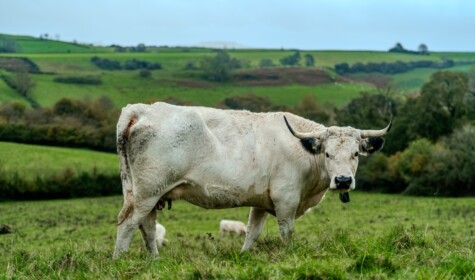
With Christmas approaching – a time for stories and renewed hope – Robert Barbour, Senior Research Manager at the Sustainable Food Trust, reflects on the six months since the launch of Grazing Livestock: It’s not the cow but the how. He examines why we urgently need the ability to imagine a different future for food and farming, and how a research-backed vision for such a future has drawn both praise and pushback.
Earlier this year, the SFT published a report looking at the debate surrounding grazing livestock. It was a labour of love (amongst other emotions) started by our late colleague and friend Richard Young, that set out to make the case that cattle and sheep actually have a hugely positive role to play in a future UK food system – one where farming practices and diets are based on the land’s ecological carrying capacity.
Since its publication, we’ve had some really engaging conversations on the issues the report covered. But with lengthening nights and the dismal advent of Christmas hyper-consumption having soured my mood this week, I’ve decided to instead tap into my inner Scrooge and reflect on some of the criticisms the report has received.
The critiques: Tough questions to consider
Most of these have posed some interesting challenges. Wouldn’t, for instance, a future that involves smaller amounts of sustainably produced meat and dairy send food prices soaring? By talking about the positives that grazing systems can deliver, or by arguing that ruminant methane is a nuanced topic, aren’t we just pushing ‘Big Livestock’ talking points? And even if our arguments do have some validity, they only apply to a fraction of the animals reared today, and therefore surely only serve to justify continued, unsustainable patterns of meat consumption?
These are important questions, which I don’t have the space to do justice to here. One key point to make, though, is that these critiques are not universally applicable in every context. Yes, arguments for nuance around methane, for instance, are abused by parts of the livestock sector – but this doesn’t mean they constitute industry denial in every instance. And yes, the pasture-based, low input ruminant systems the report argues for only supply a small percentage of the meat and dairy we consume today – but that doesn’t mean that this need always be the case.
Is it all just “romantic cottagecore”?
If we’re going to emerge from our current siloes, we need to be much more open-minded and imaginative when it comes to the arguments presented by different sides in this debate, and in our ability to imagine food systems that are very different to today’s. And this leads on to the main criticism I’ve come across of our position, which is that the less intensive, generally lower yielding approach to livestock and food production that the SFT supports is disconnected from reality – “romantic cottagecore” as George Monbiot dismissively put it.
It’s true that the vision we set out will be challenging to realise. A wholesale transition to agroecological farming practices, where livestock production is centred on pasture-based systems of mainly cattle and sheep, is not going to happen overnight. Achieving this whilst also aligning our diets to what we can sustainably produce, and in so doing reducing the amount of meat and dairy most of us consume, will be even trickier.
Taking a more strategic view
I completely disagree, however, that campaigning for a move towards this vision is naïve or detached from reality. For a start, making the case for a more agroecological future isn’t just about fostering better lives for the people, livestock and wildlife that live in our farmed landscapes (though these things are clearly worth fighting for in and of themselves). There are big strategic reasons for supporting this transition, too. Take the reintegration of grazed temporary grass and clover ‘leys’ into arable rotations. We know that this can bring all sorts of environmental benefits. But what’s probably less often considered is how valuable a role this transition could play in improving the long-term viability of arable production, by making it more resilient to climate-related shocks, and much less reliant on the energy- and fossil fuel-intensive inputs we are going to have to wean ourselves off moving forwards, whether we like it or not.
This strategic value also applies to the nutritional contribution of grazing animals. Contrary to what is often argued, this could be really significant, not just because of the quantity of key nutrients that could be produced, but also, crucially, because this would be a supply of nutrients from a feed source – forage – that humans can’t consume. And this means we’re talking here about animals which complement, rather than compete with, the crops produced from our finite and degraded arable area, unlike animals reared in heavily grain-fed, industrial systems. Again, this is a service that is only likely to become more valuable as climate change and its associated shocks increase the probability of major disruptions to domestic crop production and global agrifood trade.
Some would say that that’s all well and good, but that it doesn’t change the fact that realising this approach to livestock production and the smaller amounts of high-quality meat and dairy it would necessitate is wishful thinking. They have a point – getting people to change their diets requires overcoming all sorts of deeply embedded institutional and cultural barriers. But this is the case with any sufficiently transformative vision of a sustainable future food system! Take a future where all animal-sourced foods are replaced with analogues created through precision fermentation or other cultured techniques. It’s sometimes argued that this represents a much more plausible route to getting people to change their diets because, in effect, they’d still be eating the same foods – it’s just that they’d come from a vat rather than an animal. But is that really the case? As far as I can see, this represents a dietary shift every bit as radical and difficult to sell as the sort we support – in fact, arguably more so.
What about ‘sustainable intensification’?
The immense difficulty of the diet challenge is partly why others argue that making industrial livestock systems ever more ‘efficient’, to sate the planet’s growing demand for meat as ‘sustainably’ as possible, is the only plausible solution here. But even if we set aside the massive environmental and ethical challenges this poses, this vision also comes with big question marks over its future viability. Climate change and its associated geopolitical shocks are already having major impacts on the food system, and as these worsen, the input- and import-heavy intensive cropping systems which industrial livestock production relies on are only going to become more vulnerable – perhaps even untenable. We also know that we need to get fossil fuels out of the food system fast, and this will have massive implications for the production, and potentially availability, of the synthetic fertilisers and pesticides that form the lifeblood of industrial agriculture. It’s safe to say that the potential ramifications of this have not yet been widely enough grasped.
A realistic agroecological future – and what’s needed to get there
In short, I don’t think an agroecological future, where grazing animals play a central role, is any more implausible than the other more commonly supported visions of a sustainable food system. Neither is it a ‘fairytale’ – grazing animals can help improve the resilience of a UK food system that faces all sorts of major threats to its food security, in various ways.
There is a hugely positive story to tell here, in some ways more positive, I’d argue, than the livestock-free narrative, certainly when it comes to speaking to the farming community. And that matters, given we very obviously need farmers to be a key part of any transition. I think a lot of people and organisations realise this – it’s hugely encouraging, for instance, to see an increasing number of conservation groups showcasing pasture-based and organic livestock farms as examples of what sustainable meat and dairy production looks like in practice. All too often, though, there still seems to be a disconnect between the positioning of pasture-based livestock systems – and indeed, agroecological farming practices more generally – as case studies of sustainability on the one hand; but then, on the other, the promotion of policies or recommendations that actively work against the adoption of these systems at scale. The EAT-Lancet commission’s latest report is a recent example of this. It contains a lot of really good stuff, including positive words around the need for a shift towards agroecology. Frustratingly, though, some of its agricultural modelling assumptions (e.g. increased yields in regions where these are already high) and dietary recommendations (e.g. greater levels of chicken in the diet than red meat) are just not consistent with what a shift towards agroecology would look like in reality.
This criticism is perhaps a bit nit-picky, especially when most livestock production – irrespective of species – still has so many problems. The point, however, is that if we do want to support agroecology at scale, as many organisations say they do, then there needs to be much more clarity and joined-up thinking across all food system actors than is the case today, including of course, around the need to support a transition to low input, pasture-based grazing systems.
How do we do this? There are obviously lots of things to say here, but I’ll finish by focussing on the critical importance of measurement. Sustainability is still so often understood largely, or even solely, through the narrow lens of carbon and land use intensity metrics, that don’t just overlook a wide range of key public goods but also provide a very incomplete picture of actual climate and land use impact. Unless we develop and adopt more holistic measures of sustainability, we will find it impossible to create a food system that truly delivers for people, the planet and the landscapes that we rely upon.
You can learn more about the role of livestock in a sustainable food system by downloading our Grazing Livestock report.