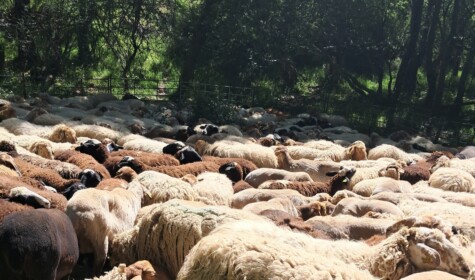
Reporting from Spain’s ancient droving routes, farmer Julie Baber shows how transhumance offers a different way of thinking about food production: one shaped by place, seasons and ecological limits. As climate change intensifies drought, wildfire and other pressures on farming, these age-old systems have much to teach us in the face of rising food security concerns.
“She carries a gun to fight snakes and hyenas”.
I was heading to the airport for a flight to Madrid and my Somali taxi driver was telling me about his 90-year-old pastoralist grandmother.
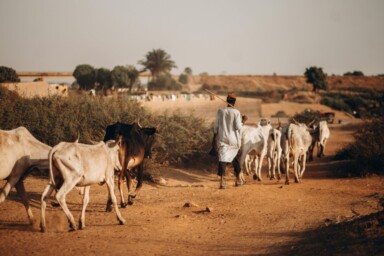
“She has 2,000 camels, goats, sheep and cows and she walks 45km to find new grass.”
It seemed a serendipitous meeting, given that I was on my way to Spain to learn about transhumant pastoralism and to take part in the annual shearing festival of the Los Apisquillos Collective in La Sierra del Rincón, which sits in the north-east area of the Madrid mountains. The collective was formed 26 years ago in the mountain village of Puebla de la Sierra, its aim to reinstate traditional rural practices and preserve the continuity of knowledge. The collective runs a flock of around 500 sheep and goats, mainly Rubia de El Molar and Negra Castellana, both rare breeds of sheep native to the region. Along with providing meat and dairy products, the flock is used for the sustainable management of mountain pasture and forest.
Lawrence Sudlow is an Englishman with a passion for the ancient droving routes of Spain and an environmental consultant and media advisor for Trashumancia y Naturaleza, an organisation dedicated to the “conservation of drovers roads as ecological highways that connect, from north to south, the entirety of the Iberian Peninsula.” He attends the shearing festival each year.
Despite the challenges, Lawrence is in no way despondent and does not see transhumance as a thing of the past. He explains how transhumant pastoralism is making not only a major contribution to high value ecosystems, but deserves to be recognised as a cultural right. As for the argument that it makes better modern economic sense to transport livestock in trucks, he is dismissive, asserting that shepherds should continue to move their flocks on foot because: “it’s the right thing to do”.
Juan García is on his knees beside the stream with an assortment of other people, felting the back of a Rubia fleece. His enthusiasm for Spain’s transhumance traditions is contagious. Working with Ecologists in Action and a key player in the transhumance campaign, he defends “both the extensive ancestral culture of transhumant livestock farming and the sustainable use of the 125,000km of livestock trails.” He points out that the ancient drove routes were given official recognition in 1273 by King Alfonso X “The Wise”, and that at this time the “Royal and Honoured Council of the Mesta,” was founded, an association of transhumant livestock farmers, with considerable de facto power.
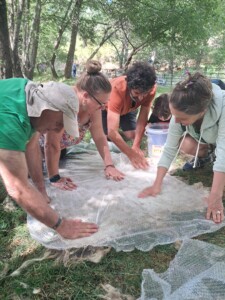
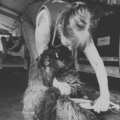
Felting a fleece at Puebla.
Juan García and Lawrence make a formidable team; along with the charismatic Álvaro, one of the founders of the collective and whose quiet authority guides its work.
The shearing festival is a joyous occasion, with music and dancing and the sharing of food. Exactly when the sheep get sheared seems to be fairly random, but the slow start gives us time to have breakfast and spend time with other members of the collective – learning how to use Sergio’s French carding machine and improvising drop spindles with bits of doweling rod and Marta’s onions.
It also gives me time to consider Lawrence’s words on the purpose of transhumant pastoralism and it being the right thing to do. For hundreds of years shepherds have exercised their right to move livestock on foot along the extensive network of drove roads or ‘cañadas’ throughout Spain. The seasonal movement of thousands of grazing animals has shaped the landscapes and contributed considerably to the high-value ecosystems of those routes, much as the migration of wild herds do in other parts of the world. In modern times the continuation of this age-old practice has become more challenging, not just for reasons such as lack of investment, rural depopulation and foreign imports, but also because of physical obstructions on the traditional routes.
Today, most shepherds use lorries to transport livestock to and from their summer and winter grazing grounds. This has led to a loss of biodiversity and a significant increase in the risk of uncontrollable wildfires due to the scrubbing up of the cañadas that formerly acted as fire breaks. Manuel Bahíllo, secretary for Trashumancia y Naturaleza, explains: “Transhumance controls the overgrowth of scrubland”. If it ceases, “all that biomass that the livestock neither eat nor trample remains in the landscape” acting as “fuel that only needs a spark to ignite”. Other transhumant farmers agree. “Fires can be stopped, that’s been proved time and again”, says Javier, a farmer from Sanabria. “The fire attacked, more or less, depending on the amount of forest fuel it encountered”.
Juan García also points to depopulation of the rural areas facilitating the “spectacular growth of forest and scrubland throughout Spain”. People like Lawrence and Juan García work hard, through their respective organisations, to keep the drove roads open, for the shepherds and for the rural population as a whole. But economics, biodiversity and fire management are only part of the picture. “The right thing to do”, encompasses all these elements but there is something else, less tangible, more instinctive and primitive, that drives it. Maybe it is an ancestral pull or just that our souls need a slower, more connected way to move across country. “Solvitur ambulando”, as the saying goes: “It is solved by walking”.
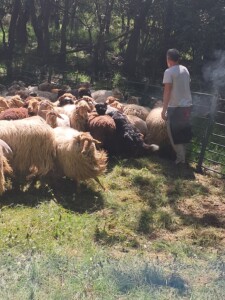
Alvaro, one of the collective’s founders, herding sheep.
Every autumn, Álvaro, Sergio, Marta and other members of Los Apisquillos, leave Puebla de la Sierra with their dogs and several hundred sheep. Over a couple of weeks, they walk the 240kms to Casa de Campo – the largest public park in Madrid. The sheep manage the park through the winter months and take advantage of the grazing at a lower altitude, leaving the mountain pastures to rest.
At a time when drought and wildfires are affecting Spain, and many other countries as never before, it is essential that the old transhumance routes stay open. Livestock needs the cooler mountain pastures through the hot dry summers; tinderbox lowland pastures need the scrub cleared by grazing livestock. The country as a whole meanwhile, needs the protection of the cañadas that cut through forests and plains.
In May, after lambing in the shelter of the park, the flock of Los Apisquillos will head home to Puebla de la Sierra, where they will be shorn and the annual cycle of extensive livestock farming continues. From the Somali grandmother to the shepherds of Spain, there are lessons here for all of us in the resilience of food systems that are shaped by place, that adapt to seasonal cycles and that support the long-term health of the land.
Learn more about transhumance and its role in wildfire management in this article by Juan García. For more about sustainable grazing livestock in a UK context, you can read our Grazing Livestock report here.