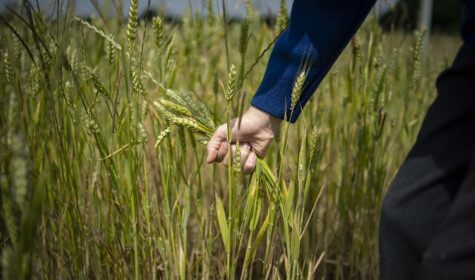
Regenerative agriculture is not defined by a single set of practices, but by the outcomes it delivers. The new Regen10 Outcomes Framework is the first globally co-developed attempt to define what those outcomes should be – across farms and the wider food system. Here, the Global Farm Metric’s Olivia Boothman reflects on why focussing on outcomes is key to unlocking regen’s potential.
In 2020, I had never heard of regenerative agriculture — despite working as a farm vet.
That changed during the early days of the Covid-19 pandemic. While headlines focused on empty supermarket shelves, I saw something different unfolding on the ground here in Cornwall, and across the UK: local farmers stepping up to feed their communities with fresh, seasonal, locally produced food.
It sparked a curiosity that quickly became a much deeper exploration (and career change!) — offering a glimpse of what our food systems could and should deliver. That was my introduction to regenerative agriculture.
Over that winter, I distracted myself from the anticipation of the dreaded pager ringing by spending many an on-call night learning. The more I explored, the more I realised that farming ‘well’ isn’t just about producing food.
I learned about the relationship between soil organic matter and climate resilience through the 4per1000 initiative. I discovered farming systems designed to support biodiversity, and community-supported agriculture models that reconnect farmers and citizens through shared risk and shared reward. Reading books like English Pastoral, I began to understand farming not only as food production, but as stewardship of culture, ecology and place.
Without realising it, I was piecing together all of the ‘outcomes’ of farming in a way that regenerates climate, nature and people.
Attending Groundswell Festival as a Masters’ student and keen to enter the world of food and farming, perhaps a little more nerdily than I’d like to admit, I frantically scribbled down notes in one of the main sessions as the speaker flashed up a slide on the five principles of regenerative agriculture.
These principles are immediately understandable. They provide practical guidance, they demonstrate what it would mean to move away from extractive and intensive systems. Ultimately though, the point of regenerative agriculture is not the adoption of specific practices in itself, but the regeneration of ecological and human systems. Therefore, regeneration cannot be defined by whether a practice is used, but by whether ecological, social and human health are improving.
In my few years of working on regenerative agriculture, one of the things that has stood out to me the most is the importance of the farm’s context. A farm is not a blank canvas that can follow a set protocol. Farms are evolving, living systems, shaped by the centuries of land-use that have preceded them. They are affected by external policies, how their neighbour farms, the climate and the weather, the economic situation.
By and large, the principles are universal enough that they can be applied anywhere. But it is also possible that two farms could follow the same principles and produce different outcomes because the landscape, culture and ecologies they are situated within differ. We need to ensure the promise of regenerative agriculture is being delivered, and to do that, we cannot rely on the principles alone.
An outcome-based approach gives farmers freedom to adapt. A mixed farm in a drought-prone region may decide that maintaining permanent ground cover is less beneficial than reducing competition for limited water availability. Another may integrate livestock to improve nutrient cycling, while elsewhere livestock numbers may need to reduce to restore degraded habitats. It enables them to have a vision of where they want to get to, and trusts that they hold the knowledge to know what will work best in their unique farm context.
But if regenerative agriculture is best understood through the outcomes it delivers, how do we create a shared language for understanding, assessing and supporting these outcomes across different contexts?
This is where the Regen10 Outcomes Framework comes in. By setting the outcomes that can and should be delivered by regenerative agriculture, Regen10’s framework aims to provide a shared vision to enable collaboration for stakeholders across the agrifood system. One of the biggest challenges in food and farming is aligning perspectives — farmers, businesses, policymakers and NGOs often come at things from completely different angles. Frameworks like the Sustainable Development Goals (SDGs), and more recently the Global Biodiversity Framework (GBF), have shown how powerful it can be to anchor conversations in agreed outcomes: they don’t prescribe how to act, but they do create a common language for what success looks like. That shared direction makes collaboration, accountability and investment decisions much more tangible.
When I started out in this area of work, it was a real challenge for people to consider anything beyond climate change mitigation, improving biodiversity and water quality and availability as core outcomes of regenerative management. However, after extensive consultations, farm trials, and discussions among Regen10 partners, we all agreed that true regeneration was wider than these ecological outcomes. The Regen10 outcomes framework defines these outcomes, taking the Global Farm Metric framework as its foundation, and building these out, through collaboration and dialogue to a set of outcomes recognised by those who are implementing change.
Perhaps one of the most important things about understanding regenerative agriculture through outcomes is that it prevents us from treating regeneration as a fixed state to be achieved. If regeneration is continuous, no farm can ever be ‘fully regenerative’. Instead, an outcome-based approach asks harder, but ultimately more useful questions. Is soil health improving? Is biodiversity thriving? Are farming livelihoods becoming more prosperous? Are communities healthier?
What drew many of us to regenerative agriculture was never simply a set of principles, but the idea that farming could not only produce food, but also restore nature, improve health, and reinvigorate communities. Now we need to continue the work to make sure this becomes a reality.
Building on the foundations of the Global Farm Metric, the Regen10 Outcomes Framework has been co-developed with farmers’ organisations, conservation groups, businesses, Indigenous Peoples, civil society, and landscape initiatives worldwide. It offers a shared global reference point for aligning efforts across sectors, scales, and geographies. Click here to find out more.