What’s in your food and how can you eat better? In this series, we look at some staple meals, considering what’s good for you and what’s maybe not – and how you can turn them into dishes that are healthier, better for the planet and alive with flavour.
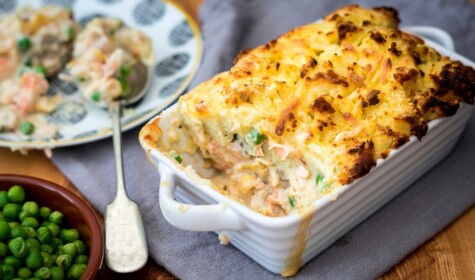
Fish pie is one of life’s greatest comfort foods – the beautiful flaky pastry (or alternatively, yummy whipped potato topping), the creamy, tangy roux that envelopes the fish, the tasty additions you may love.
But sadly, many of the fish typically used in this dish are from populations on the verge of collapse. A recent report by Oceana UK on the state of UK fishing detailed the troubled waters: “over a quarter (27%) of the UK’s commercial fish populations are overfished to the point of having critically low population sizes, and 25% are being overexploited”. Many prized UK fish and crustaceans continue to be overfished, most notably North Sea cod and crab (in the Southern North Sea). And the most depressing thing about this, is that government bodies have done nothing over the years than to continue business as usual, allowing quotas to overreach scientific thresholds for the health of fish stocks, causing them to decline in peril.
So, what are the options here for that fish pie? Well, luckily there are some.
A good choice is Cornish, gillnet caught hake, which has been gradually replenishing since the early 2000s. In 2015, the Marine Stewardship Council (MSC) certified the fishery as sustainable. Hake is a firm fish, much like cod but much more sustainable, and it’s ideal for fish pie. Also, look at other options such as Scottish haddock, coley and whiting to mix it up a bit. And keep in mind what often gets discarded – cod cheeks for example, which are a succulent overlooked bit of the fish.
A recent report by Oceana UK on the state of UK fishing detailed the troubled waters: “over a quarter (27%) of the UK’s commercial fish populations are overfished to the point of having critically low population sizes, and 25% are being overexploited”.
Sadly, for those who like prawns in their fish pie, they’re really not that sustainable anymore. The best shrimp option in the UK is brown shrimp, but these are caught in a bottom trawl (beam), which is a highly destructive form of fishing associated with a high amount of by-catch (unwanted species that are then discarded). The MSC give wild-caught brown shrimp from The Wash a ‘Best Choice’, but the damage done to the seafloor and the benthic organisms that live there remains problematic, while North Sea shrimp need improvement. Scallops are a delicious alternative for a real treat in your fish pie, but be prepared for the price of them.
Farmed salmon might seem like a good way of avoiding damage to wild stocks, but in reality is best avoided. As well as issues like mass mortality and sea lice, one of the many problems of fish farming is what the fish are fed. In the case of salmon, it takes more than a kilo of wild fish to produce a kilo of farmed salmon.
Delia Smith’s Flaky Fish Pie
You don’t have to do Delia’s recipe for fish pie, but it’s a hard one to beat and it’s easy.
This recipe is from The Delia Collection: Fish (serves 4)
Ingredients
For the pastry:
- 8 oz (225 g) plain flour
- 6 oz (175 g) butter
- a pinch of salt
- beaten egg, to glaze
For the filling:
- 12 oz (350 g) any white fish
- freshly milled black pepper
- about 12-15 fl oz (330-425 ml) milk
- 1 oz (25 g) butter
- 2 level tablespoons plain flour
- 1 level tablespoon capers, drained and chopped
- 4 small gherkins, drained and chopped
- 2 level tablespoons chopped parsley
- 2 hard-boiled eggs, chopped
- 1 tablespoon lemon juice
You will also need a baking sheet measuring 14 x 11 inches (35 x 28 cm), greased.
- Chill the butter for the pastry (in foil) in the freezer for 30-45 minutes. Sift flour and salt and grate the cold butter into the flour, mix with a palette knife, sprinkle 2-3 tbsp of cold water, bring together and chill for 30 minutes.
- For the filling: poach the fish in just enough milk to cover for 5-10 min, reserve the milk, flake the cooled fish (remove skin/bones) and set aside.
- Melt butter in the same pan, stir in the flour, cook for 2 minutes, gradually add the reserved milk (300 ml), stirring constantly. Bring to the boil, simmer for 6 minutes, remove from heat and stir in the fish, capers, gherkins, parsley, chopped eggs, lemon juice and salt and pepper. Leave to cool until quite cold.
- Pre-heat the oven to Gas Mark 7 / 220 °C (425 °F). Roll the pastry to 30 cm square; lift onto a greased baking sheet. Place the cold fish mixture in the centre. Brush the edge of the pastry with the beaten egg. Fold opposite corners to the centre, pinch the edges to make a cross shape and glaze the top and any pastry trimmings with the beaten egg. Bake for about 30 minutes, or until pastry is well risen and golden.
To read the other articles in our ‘Making More of Your Meal’ series, click here.