It’s that time of year again – we’ve compiled our favourite reads from the last 12 months, enough to keep you busy until next year!
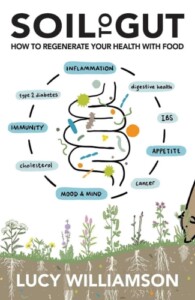 Soil to Gut: How to regenerate your health with food
Author: Lucy Williamson; Publisher: 5M Books Ltd
Reviewed by Victoria Halliday
Working for 15 years as both a farm and small animal vet, before training as a public health nutritionist, Dr Lucy Williamson brings a unique perspective to the relationship between food and health.
With Soil to Gut, her aim is to help readers move beyond heavily marketed food fads towards a more grounded and joyful approach to eating. Taking a ‘whole health’ approach, Dr Williamson focuses on the gut microbiome and how it influences many aspects of our wellbeing. By understanding how different foods nourish – or deplete – us, we can create a gut environment in which beneficial microbes are better able to outcompete those that may be harmful.
Soil to Gut shows how this science translates into everyday cooking and eating, taking readers on a journey through the main food groups and explaining how different foods interact with our bodies. At the heart of Dr Williamson’s approach is the connection between the health of our soils and the health of people. A healthy soil ecosystem drives the nutrient cycle: “the natural loop that moves nutrients from soil, through plant roots, into pasture for grazing animals or into crops that feed us”. As soils have become depleted and increasingly reliant on chemical inputs, the nutrient density of many foods has declined. Dr Williamson argues that this is one of the factors contributing to the epidemic of ‘hidden hunger’, where we consume enough calories but insufficient nutrients. She suggests that, at an individual level, we can help counter this by choosing food with a better story behind it and, at a systems level, by supporting farming practices that prioritise soil health.
Throughout the book, Dr Williamson combines accessible explanations with practical recipes and tips that make the science easy to apply in the kitchen. Rather than prescribing a rigid way of eating, she encourages readers to build a more diverse, nourishing and enjoyable diet while thinking more deeply about where their food comes from. For anyone interested in the links between farming, food and health, Soil to Gut is an engaging, evidence-informed guide that offers practical advice alongside a compelling case for reconnecting the health of people with the health of the land.
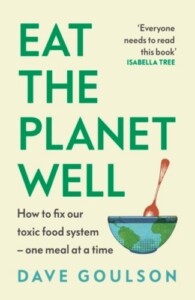 Eat the Planet Well: How to fix our toxic food system – one meal at a time
Author: Dave Goulson; Publisher: Jonathan Cape
Reviewed by Alicia Miller
Noted environmentalist David Goulson has written widely about the wonder of insects and their importance to our survival as humans. But in this latest book, Eat the Planet Well, he steps into much broader territory, interrogating the monumental problems of our food system which, he comments, is ‘toxic to us and toxic to our planet’.
Food has largely become a danger to us. The arrival of ultra-processed foods, especially in the UK and US – but increasingly across the world – has led us down a path to ill health and one that it is hard to escape from. We are not only suffering from non-communicable diseases, but we are also consuming an array of pesticides and forever chemicals among other dangers, when we sit down to eat. Further, and arguably more importantly, the intensive nature of our industrial food system is not just destroying our health, it is also rampantly working to destroy our nature – and without nature, we face a denuded and devastated planet that will feed us poorly.
Goulson covers a lot of ground in Eat the Planet Well – understanding the problems of our industrialised food system is a good starting place for changing how we eat. Farming organically with an understanding of nature’s value is vitally important. There is an essential balance that is lost when the lives of animals are degraded, plants are sprayed heavily with pesticides and soil health declines. Goulson maps out the problems step by step, helping us to think again about how we eat and what we can do to eat better. Each chapter focuses on a specific issue – Carbon, Cows and Climate Change, Should I Buy Local Food, Limited Land and Water and onwards. It’s a comprehensive analysis of what is needed to create a kinder, gentler world that will truly feed us well.
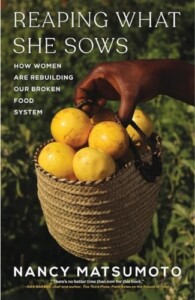 Reaping What She Sows: How women are rebuilding our broken food system
Author: Nancy Matsumoto; Publisher: Melville House Publishing
Reviewed by Victoria Halliday
To say that our industrialised food system is broken has become a familiar refrain. We hear it so often, yet supermarket shelves remain full and life carries on much as normal. It’s easy to tune out the warnings and keep filling our trolleys. After all, what is it that we’re actually able to do?
Reaping What She Sows by Nancy Matsumoto shows that there is in fact much we can and must do, if we’re going to revive our ailing food system. The book serves as a powerful antidote to apathy, telling the stories of women around the world who are rolling up their sleeves to rebuild food and farming for the better, bringing their remarkable ingenuity, tenacity and compassion to the task.
Matsumoto shows how cooperative movements and creative solutions have been born out of systems of oppression, and how these might energise today’s efforts to build an alternative food system in the face of Big Food oligarchies and late-stage capitalism. Women have historically been important leaders in food production and distribution, but in many modern societies, they have been relegated to the margins of male-dominated industrialised systems. Yet it is precisely because they have been excluded from the dominant system’s centres of power that women have emerged as early adopters of progressive food system change.
The stories that Matsumoto shares are remarkable. She meets women who have dedicated their lives to pushing for racial justice in agriculture, who are working to rebuild local grain economies, who are coordinating vertically integrated cooperatives that protect smallholders, who are forging the way in building sustainable fisheries – and many more. By exploring the messy human realities alongside the broader systems at play, Matsumoto creates a fascinating read. Reaping What She Sows is recommended for anyone seeking inspiration in their own work or simply looking for a refreshing dose of optimism and agency about the future.
Importantly, Matsumoto reminds us that change is not only the preserve of policymakers and producers. As consumers, we also have the power to catalyse the transformation of food and farming: “Sometimes a short, ethical supply chain product is hidden in plain sight in a [megastore]. The onus is on us, the consumer, to look for companies that we know are part of the alt system we want to support.”
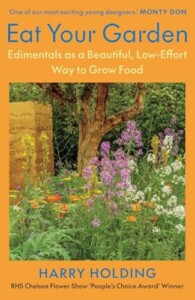 Eat Your Garden: Edimentals as a beautiful, low-effort way to grow food
Author: Harry Holding; Publisher: Chelsea Green Publishing
Reviewed by Isabel Eaton
For those who grow their own food, this has not been an easy summer. High temperatures combined with little to no rainfall have made the watering of thirsty fruits and vegetables a seemingly endless task and, against the backdrop of drought and hosepipe bans, one tinged with a distinct sense of unease. In gardens and allotments across the country, many will be asking themselves whether the time has come to do things differently – Harry Holding’s new book, Eat Your Garden, may well hold a solution.
Award-winning garden designer and life-long fan of growing-your-own, Harry Holding is a passionate advocate for ‘edimentals’ – plants that look good, taste good and do good for biodiversity and the soil. Doing away with the idea that edible and ornamental plants are distinct entities, with the former often confined to the allotment or functional beds hidden at the bottom of the garden, Eat Your Garden sets out the case for putting edible plants at the heart of garden design for reasons of both sustainability and beauty.
The benefits of perennial edibles, Harry explains, are manifold. Because they have time to develop strong root systems, they are more resilient in the face of challenging weather conditions and pests, as well as being better for the soil, improving structure and reducing disturbance. Once established, they are also lower in effort and cost as there is no need to resow and plant them each year. And with such a wide variety of plants available, they can provide just as much aesthetic interest in the garden as their non-edible equivalents.
In this accessible and practical guide, Harry shares the profiles of some of the plants he commonly uses in his designs (from familiar favourites such as fennel and chives to many you may not have known were edible, such has Hostas and Lamb’s Ear); he explores the principles of planting design in the edimental garden, and offers insights into some of the most exciting and experimental edimental gardens from around the world. Photos throughout the book help to bring the topic to life and make this a highly readable introduction to the world of edimentals, which may well get gardeners thinking differently about how to produce food in a changing climate.
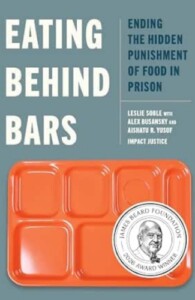 Eating Behind Bars: Ending the hidden punishment of food in prison
Authors: Leslie Soble, Alex Busansky & Aishatu R. Yusuf; Publisher: New Press
Reviewed by Imogen Crossland
Eating Behind Bars is an essential read for anyone who wants to better understand America’s broken prison system and how it might be fixed. Winner of a James Beard Foundation Media Award, the book follows a landmark 2020 investigation of the same title, exploring the woeful state of prison food in the US. Leslie Soble and the team at Impact Justice, a US-based non-profit working to reform the criminal justice system, shed light on an issue that has, until recently, received little public attention. What goes on behind prison doors is so often out of sight, out of mind.
Grounded in the unflinchingly honest words of incarcerated people, their family members and prison staff, the first half describes rat-infested kitchens, rotten food and drinking taps running with brown water that “sparkles” with flecks of metal. The fact that many of the people subjected to these meals are also forced to work on one of America’s industrial-scale prison farms feels especially ironic – producing food for the mass market under horrific conditions, without ever tasting it themselves.
What follows, however, is an uplifting collection of stories: of initiatives and individuals working tirelessly to bring about change. From San Quentin prison in California, where a movement led by residents has produced a ‘Scandi-style’ plan to transform the food environment, to the ‘Chefs in Prisons’ programme in Maine, where Michelin-starred chefs swap restaurants for prison kitchens, supporting staff with menu design, local sourcing and reducing waste, these examples show what meaningful reform can look like in practice, and leave you feeling optimistic that change is possible.
The idea that ‘food is medicine’ is a powerful core message, and incarcerated people understand better than anyone the impact poor nutrition has on physical and mental health, as well as the restorative potential of good food. It’s also made clear that reforming prison systems doesn’t just benefit those inside – the effects reverberate far across families, local communities and the natural environment.
It’s a radical book on an important issue, one that ultimately affects all of us. The following quote really captures the heart of it: “We’re not making anyone safer by wielding food as a weapon of punishment. Safety comes when people’s fundamental needs for shelter, sustenance, connection, and purpose are met, and when we treat each other with care and respect.”
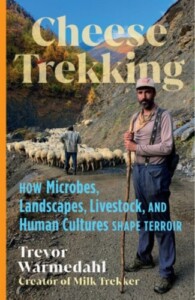 Cheese Trekking: How microbes, landscapes, livestock and human cultures shape terroir
Author: Trevor Wamedahl; Publisher: Chelsea Green
Reviewed by Anna Heinlein
Last year, I made around 900 litres of cider and perry using only the wild yeasts naturally present on the fruit. For me, that’s what terroir is all about: the microorganisms that reflect the place where the apples and pears were grown, capturing the uniqueness of an orchard and the fruits it produces. I’d always thought about terroir in relation to cider, perry and wine, but I did have a real lightbulb moment when I read Trevor Wamedahl’s Cheese Trekking– the same living microbial communities shape cheese too.
Cheese Trekking takes you on a journey through landscapes and cultures, introducing the people, animals and environments behind some rare and remarkable cheeses. Wamedahl brings each place vividly to life, whether it’s sheep grazing through Mediterranean scrub in Italy among the deep red flowers of sulla, or herders air-drying yak milk cheese on the roofs of their ‘gers’ (circular structures known to many as yurts) in the Mongolian steppe. Along the way, he explores the agroforestry and pastoral systems that have evolved alongside these native livestock breeds and traditional foods, showing how closely they are intertwined with the landscapes that sustain them. He describes this as ‘deep terroir…a direct aromatic correlation exists between a cheese and the place it is made’.
Many of the cheeses Wamedahl explores are made without a starter culture – the cheeses are shaped by four factors (he calls them the ‘layers of terroir’): the livestock (breed, herd size and health); the location,which influences their feed, its mineral content, and the water and air they breathe; and a community of beneficial microbes living on the cheese. This is, then, all brought together by human cultural practices. ‘To this day, the recipe lives on in a cultural body, the amassed multi–generational experiential knowledge passed down by doing the work and honing the senses to the standards set by tradition. It is this knowledge – combined with the tools, materials, and techniques that forms the layer of cultural terroir. The people are the recipe.’
Wamedahl also reflects on his own journey from conventional cheesemaking towards a much deeper appreciation of traditional methods, while questioning how packaged starters and standardised processes have shaped the cheeses we produce and eat today. It was fascinating to learn that, despite these pressures, pockets of truly natural cheesemaking continue to survive. The book has certainly encouraged me to seek out smaller producers, both at home and when travelling.
The book can be a bit technical at times, but I appreciated the details and there’s a good glossary for your questions. The chapters are easily dipped into independently, so whether you’re curious about Sicilian Pecorino one day or yak’s milk cheese the next, this is a perfect summer read for anyone interested in food, farming and the ways that a place and its people shape what we eat.
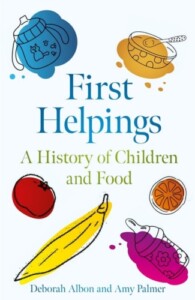 First Helpings: A history of children and food
Authors: Deborah Albon and Amy Palmer; Publisher: Reaktion Books
Reviewed by Amy Warner
First Helpings is a rich and revealing history of a subject hiding in plain sight: how British children have been fed, taught to eat, put to work, and sometimes left to go hungry, from the medieval period to today. Albon and Palmer, both former lecturers in early childhood studies, bring genuine scholarly rigour to the project, but never at the expense of storytelling. The book opens with the testimony of a Victorian child street-seller, and that commitment to surfacing children’s own voices, so often missing from the historical record, runs through the book.
The range of material is what makes the book sing. Court records of vagrant children sleeping under London market stalls sit alongside Roman physicians feeding advice, wartime rationing schemes, GCSE cookery statistics, and even a properly entertaining detour through breastfeeding anxiety in Game of Thrones. Contentious topics such as breast versus bottle, discipline at the table, and whether the state should feed the child, are addressed with real even-handedness, and gendered labour is a persistent, well-drawn thread in who learns to cook and why.
The final chapter on hunger, bringing centuries of evidence right up to today’s UK food poverty statistics, gives the whole book its urgency. Neither author is a parent, and they say so plainly — this isn’t a parenting manual, but something more useful: a clear-eyed history of just how contested “the right way” to feed a child has always been.
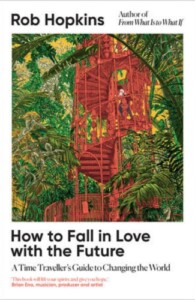 How to Fall in Love with the Future: A time traveller’s guide to changing the world
Author: Rob Hopkins; Publisher: Chelsea Green Publishing UK
Reviewed by Alice Frost
It seems increasingly difficult to find a solid non-fiction read about the climate, nature and environmentalism, that isn’t also incredibly unsettling and anxiety-inducing, so let me introduce you to How to Fall in Love with the Future: A time traveller’s guide to changing the world…
How to Fall in Love with the Future does touch on the devastating consequences that our reliance on fossil fuels, intensive agriculture and mass consumerism has caused, as well as the disproportionate damage capitalism, and most notably, the world’s richest have inflicted on the planet, but this is balanced out by offering a genuinely hopeful light at the end of the tunnel. That light? A time machine.
Hopkins is not talking about literal time travel of course – though how cool would that be – he’s talking instead about the power of our imagination and its untapped potential, envisioning a future where we’ve collectively put words into action and begun to make progress so that we can confidently look to the future and smile – rather than grimace.
How to Fall in Love with the Future shares a radical yet entirely credible lens on the future, reminding us of our agency to create a better future for ourselves and the next generation – totally opposite from the one we’re constantly being told is inevitable and that it’s too late to change the outcome now. It’s true: the future hasn’t been written yet, but we need change and we need it urgently.
However, Hopkins doesn’t inspire hope through purely positive sentiments and cautious optimism – he shares real world examples where transformative initiatives across the world are already creating real change: from a successful local food system in southeast France, where 80% of the food served in schools comes from a local market garden (and is 100% organic!), to the (almost) entirely car-free Vauban district in Germany, where for every 1,000 residents, there are only 172 cars.
By imagining time travel is possible, Hopkins dares us to imagine what we’d want 2030 to look like. Is it greener, cleaner, more colourful? What can you smell? Fewer fumes, home-cooked meals wafting from open kitchen windows, pollinating flowers of the city’s sprawling urban gardens? What can you hear? Bird song, children playing outside, no impatient beeping of car horns? Whatever it is you imagine, Hopkins urges us to question why this can’t be our reality. Think about the small adjustments we can all make to create change, and be cautiously optimistic and hopeful in the eye of very uncertain times.
If you’re looking for a read this summer that will lift your spirits amongst the intense despair and gloom, How to Fall in Love with the Future will do exactly that – this book will dare you to imagine ‘what if?’ and reignite your activism. I’m looking forward to Hopkins’ follow-up: Falling in Love with the Present in 2030…!
And don’t miss these other reads…
The Future of Food Policy in the UK: Recipe for Change
Author: Honor May Eldridge
“This book makes a compelling case for the urgent need to develop a new approach to food and farming—one that integrates the principles of food security and sovereignty. In the face of escalating challenges such as climate change and increasing political instability worldwide, it is essential to rethink food production and future-proof it by prioritising resilience.”
The Last Cows: On Ranching, Wonder, and a Woman’s Heart
Author: Kathryn Wilder
“Told from the unique perspective of a woman, mother, environmentalist, cowboy, and rancher, this work of literary nonfiction conveys the joys, challenges, heartbreaks, and qualms of contemporary ranching in the American West.”
Gather: Black Food, Nourishment and the Art of Togetherness
“How can we create a world where everyone has enough? We can start by focusing less on lack and more on abundance. In Gather, anthropologist Ashanté M. Reese argues for a new vision of food justice that centres the resilience of Black communities and argues that community nourishment deserves as much consideration as individual health.”
After more food and farming inspiration? Read our 2026 film and TV reviews here.